


The Perfect Posture Test shows your client, standing, in centimeters and on three planes, how their posture organizes itself before and after. Fifteen minutes, without changing anything about your session.
You see the protocol live, you ask your questions, then you decide. Certified tester: your kit is refunded if, after one month of documented tests, nothing changes with your clients.
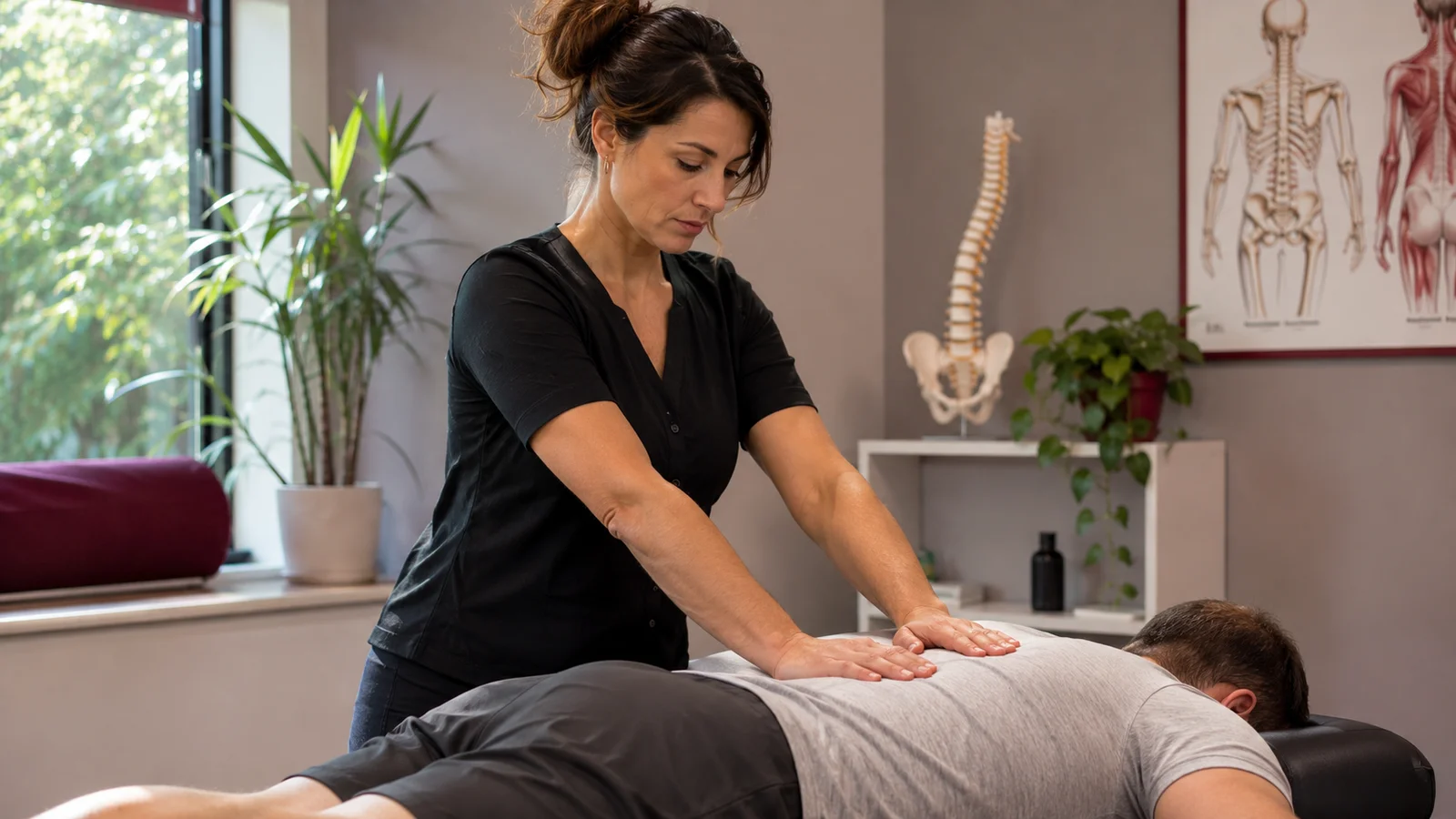
Your client walks in with a ready-made idea of what you do. And explaining your work in two sentences is anything but simple.
At the end of the session, they feel different. But to show it, all you have are their words, and yours.
And talking about a product makes you uneasy. You support people, you don't sell to them.
Your approach runs through touch and perception: you sense, they feel. The Perfect Posture Test adds what that exchange is missing, a marker you can both see: postural shifts in centimeters, neck rotation scored out of 7, strength tests that give way and then hold.
You don't become a salesperson: you become a tester. You show a number, before and after; if the result is there, you recommend the technology. When the person wears the technology that matches their biophysical profile, their posture reorganizes within 12 seconds, in front of you, and holds for as long as they wear it. Your client decides for themselves.
Illustration of the reading: before, then while wearing the circuit. Not a result.
The full presentation video is coming soon. Want to go further right now? Ask for it: we'll send it to you privately as soon as it's out. Or see everything live, questions included, during the 60-minute presentation.
Functional assessment, not medical · Before/after protocol · Observations from internal tests · Individual results vary · Not a medical claim. Rolfing® is a service mark of the Dr. Ida Rolf Institute; Q-Technology is not affiliated with it.
You already know this: the nervous system organizes posture and tone, and a compensation eventually becomes the norm. That science explains how a compensation sets in. It doesn't explain how Q-Technology works.
The circuit is passive and resonant, with no battery and no electrode. It picks up ambient electromagnetic energy within its resonance band and returns a coherent low-frequency signature, read by the nervous system: that is our hypothesis. The foot is a convenient location, not the mechanism; the circuit also works when worn elsewhere.
And the fascia? We don't claim to act on it. The test shows how posture is organized while the circuit is worn; any link to fascial tissue remains a hypothesis that nothing measures today.
It's a support, not a cure. Like glasses: you wear them, you see; you take them off, you don't.
Why this isn't applied kinesiology. Standardized protocol, a single push signal, a sham circuit, a blinded observer. Knowing what you're wearing changes what you feel; that's why we test blind.
Where the research stands. More than 30 years of measurements in the patents, and 21 different devices in our pilot research. Science doesn't yet explain every mechanism of action: we still lack devices precise enough to measure, in biophysics, what happens in the body.
Show before you explain: a number, before and after, in front of your client.
Repeat the measurement your client is waiting to see.
Describe a standardized, blinded protocol without having to defend your method.
Be the testing point people in your city find when they look for a tester.
Depending on the rules of your profession and your country, you can be paid for the tests you run and earn a commission on the products you recommend. The details are covered on the call. An opportunity, never a guaranteed income.
At the end of the session, the practitioner invites them to stand up for the test. They measure pelvic and shoulder shifts, neck rotation and how the strength tests hold, without a circuit and then with one. The client sees for themselves whether anything has moved in how they organize themselves standing, and decides whether they want to know more.
At the start of the series, the practitioner takes a baseline measurement. At the following appointments, they repeat the same protocol under the same conditions. The client compares their own readings and watches whether their standing posture organizes itself differently, or not.
Before starting, the practitioner walks them through the protocol: an identical push every time and a dummy circuit slipped in among the real ones. The test runs, and stability and strength are noted at each pass. The client looks at their readings, makes up their own mind, then chooses whether to go further.
Composite illustrations to help you picture it. These are not testimonials: real tester feedback will replace this block as soon as it is published.
Training and kit: presented on the video call, prices included.
If we think it isn't for you, we'll tell you.
If, after one month of documented tests with your clients (training completed, practical exam passed), nothing changes, your kit is refunded. It comes back complete, at your expense; the original shipping stays at your expense. The training itself is never refunded: it's a professional purchase, already completed (Certified Tester contract, art. 11.2).
All professions combined, as long as the license is active. Check the map to see if your area is still open. Your town isn't on it? The map only shows towns large enough for a testing point: write to us and we'll look at your region with you.
You don't become a salesperson: you become a tester. You run the test, your client sees the change for themselves, and if the result is there, you recommend the technology. We're looking for credible professionals who recommend what they've seen, not salespeople. Depending on the rules of your profession and your country, you can be paid for your tests and earn a commission on the products you recommend. In practice, many testers set it up this way: the test happens during the appointment, and both the recommendation and the commission go through a separate business, your own, run outside your consultation hours. You simply tell the person. Check with your regulatory body what your profession allows.
We don't say otherwise. The foot is a convenient location, not the mechanism: the circuit works when worn elsewhere. What you offer is a measurement test, not an action on the fascia.
No. The test is done standing, before or after the session, in fifteen minutes. Your session stays yours, and we never present the test as part of your method.
No: standardized protocol, a single push signal, a sham circuit, a blinded observer.
More than 30 years of measurements in the patents, and 21 different devices in our pilot research. Science doesn't yet explain every mechanism of action. The simplest thing is to get tested yourself. A pointed question about the mechanism: Nicolas answers that best, on the video call.
So have we. Get tested, and judge for yourself.
The test takes fifteen minutes and fits at the start of a follow-up. The training is online, at your own pace: about a day and a half for Junior, three and a half days for Senior.
The price is stated in full: Q-Go insoles €329, Q-Pro insoles €499, circuits alone from €279. Two-year technical warranty on the circuits (Terms of sale, art. 28).
First, you experience it yourself. Then, the guarantee: your kit is refunded if nothing changes after one month of documented tests.
The test is a functional assessment, not a medical one. The rules of your profession apply: we go over them together on the video call.
The Perfect Posture Test reveals whether a person responds to Q-Alpha, Q-Theta or Q-Omega. About one person in two hundred doesn't reach perfect posture with any of the three.
P.S. You don't have to take anything on faith. In 60 minutes, you see the protocol. If you become a tester and nothing changes with your clients after one month of documented tests, your kit is refunded. What really costs you is another year of explaining what your clients could simply see.
Book my 60-minute presentation →