


For physiotherapists, osteopaths, sports coaches, yoga teachers and science-curious movers
Fascia as a Sensory Organ: What Neurobiology Has Known Since 2003 — And What Your Training Still Ignores
6 times more nerve endings than muscle. Contractile properties of its own. A tensegrity network connecting every cell to the whole. The science of fascia has advanced. Has your training program?
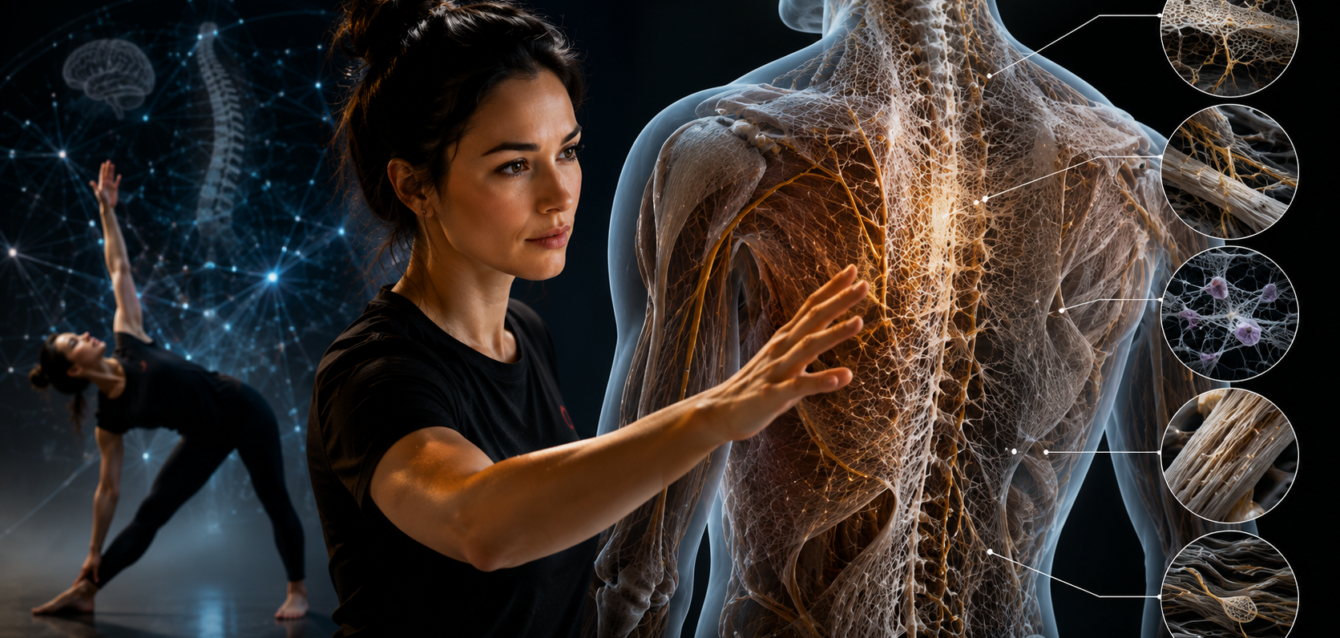
If your training program doesn’t mention fascia — it’s outdated. Not because fascia didn’t exist before 2003. Because in 2003, Dr Robert Schleip published something important in the Journal of Bodywork and Movement Therapies. He explained why fascia is not padding tissue. He showed it’s an active, contractile, innervated sensory organ that plays a direct role in your posture, pain, and motor control. Twenty years of research have since confirmed and expanded this. In 2024, a review in Frontiers in Neurology stated clearly: fascia is a full regulatory system. Not a filter. Not packaging. A system.
Fascia is not padding tissue: the Schleip revolution (2003)
For decades, anatomy dissections threw fascia in the bin. Literally. It blocked the view of muscles, bones, organs. They cut it out. They moved on. In 2003, Robert Schleip changes everything. In ‘Fascial plasticity — a new neurobiological explanation’ (Journal of Bodywork and Movement Therapies), he shows that fascia contains a higher density of mechanoreceptors than muscle. Ruffini, Pacini, interstitial corpuscles — all present in fascial tissue, all capable of sending signals directly to the CNS. In 2005, the same team confirms another finding: fascia has contractile properties of its own, via cells called myofibroblasts. Under stimulation, fascial contraction can increase by 25%. Not a metaphor. Measured in vitro.
Tensegrity: why your body is not a stack of Lego bricks
The word comes from architect Buckminster Fuller. Tension + integrity = tensegrity. A structure that holds through the balance of tension and compression forces — not through rigidity. In 2007, Donald Ingber (Harvard Medical School) applies it to the human body. His thesis: from molecules to cells, from cells to tissues, from tissues to the whole body — everything is organized according to tensegrity principles. A recent review in ScienceDirect (2025) confirms this biomechanically: in vitro, fascia transmits up to 30% of mechanical forces between muscles. Myofascial transmission is real.
The myofascial unit: muscle + fascia = one motor command
In 2002, Italian surgeon Luigi Stecco creates a new concept: the myofascial unit. Muscle and fascia form an inseparable anatomical and functional unit. When one contracts, the other receives and transmits. A narrative review published in MDPI (2023) confirms: ‘muscle can no longer be considered the sole organizer of movement.’ The myofascial unit is the basic structure of peripheral motor control. In 2021, Hélène Langevin (NIH) publishes in Life Sciences: ‘Fascia mobility, proprioception, and myofascial pain’. She confirms the link between fascial restriction, degraded proprioception and chronic pain.
Tensegrity Training: what you can do concretely
Training fascia means training myofascial chains — not isolated muscles. Spiral and diagonal movements. Fascia organizes in oblique lines crossing the body. Thomas Myers’ Anatomy Trains (2001/2014) maps these lines. Moving diagonally, spirally, rotationally activates entire fascial chains. Slow stretches with progressive load. Fascia responds to slow deformation. Not to violent 30-second stretching. Gentle, sustained pressure for 60–90 seconds modifies fascial viscosity and activates Ruffini mechanoreceptors. Controlled rebound. The elastic component of fascia stores and returns mechanical energy. Regular gentle rebound movements (light plyometrics) maintain this elasticity.
Q-Technology and fascial work
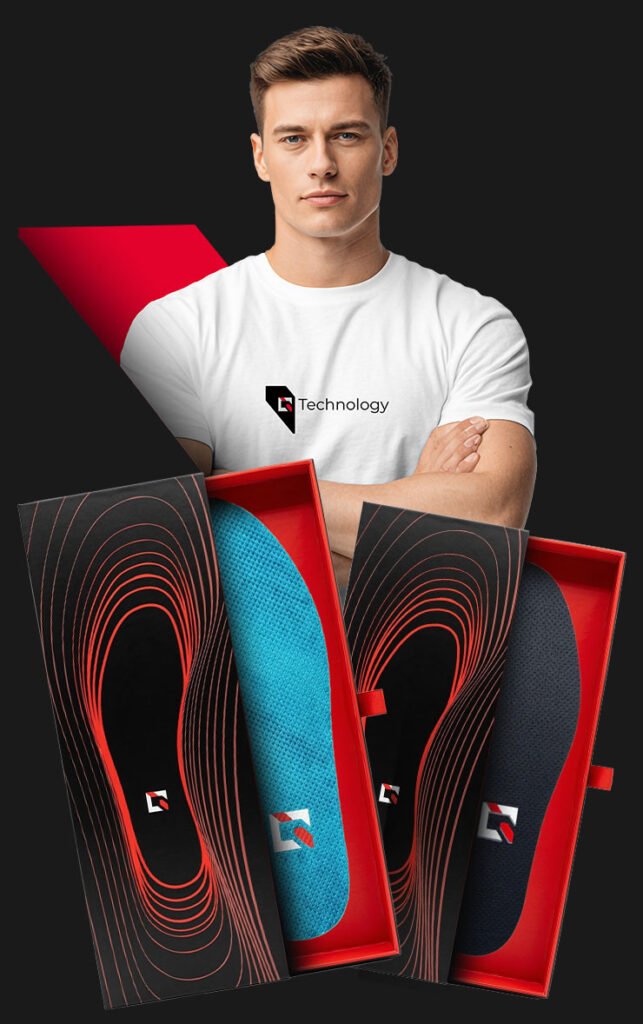
Q-Technology chips or insoles calibrated to your biophysical profile add a specific mechanoreceptive stimulation layer to the nervous system. The entry point is the plantar afferents — exactly as documented by Kavounoudias & Roll (Journal of Physiology, 2001 and 2003). In the context of fascial work, this produces two observable effects: postural recalibration across all 3 planes (observable in the 10 demo tests), and a stabilized sensory baseline from which spiral and myofascial exercises execute with fewer parasitic compensations. Harmonia profile (Q-Go): universal entry point, effects on general tone and anchoring. Alpha, Theta, Omega profiles (Q-Pro): individually calibrated via the Perfect Posture Test (15 min, certified tester).
The 3 errors that damage your fascia
Error 1 — Violent 30-second stretching. You pull hard, hold 30 seconds, release. Your fascia doesn’t relax — it defends. Golgi and Pacini mechanoreceptors respond to threat with reflex stiffness. Error 2 — Systematic muscle isolation. Weight room machines isolate a muscle. Fascia is continuous. You strengthen a muscle without calibrating the network. Result: asymmetries and chronic tensions that keep reappearing elsewhere. Error 3 — Always wearing shoes. The plantar sole is the primary contact point with gravity. Plantar fascia contains dense mechanoreceptors. Constantly wearing heavily cushioned shoes attenuates this signal (Lieberman et al., Nature, 2010).
Test the state of your myofascial network now
Test 2 — Overhand diagonal: youtu.be/FKlQlU_qxSY Test 3 — Hook hands: youtube.com/shorts/yF6SynMiS3M Test 7 — Quadratus lumborum: youtu.be/2pKMWAHJEcg Test 9 — Trunk rotation: youtube.com/shorts/MDc4BSouWj0 Full HUB video (10 tests): youtu.be/TshswH2CSig Find a certified Q-Technology tester near you. 1 tester per 100,000 inhabitants — verifiable on Google Maps. → [MAP LINK] Perfect Posture Test: €33 — refunded if zero objectifiable result.
Scientific references
• Schleip R. — JBMT, 2003 • Schleip R. et al. — JBMT, 2005 • Ingber D.E. — Harvard Fascia Research Congress, 2007 • Stecco L. (2002) / Stecco et al. — MDPI, 2023 • Langevin H.M. — Life Sciences, 2021 • Slater A.M. et al. — Frontiers in Neurology, 2024 • ScienceDirect review, 2025 • Lieberman D.E. et al. — Nature, 2010 • Kavounoudias A. & Roll J.P. — Journal of Physiology, 2001 and 2003 • Myers T. — Anatomy Trains, 2001/2014