


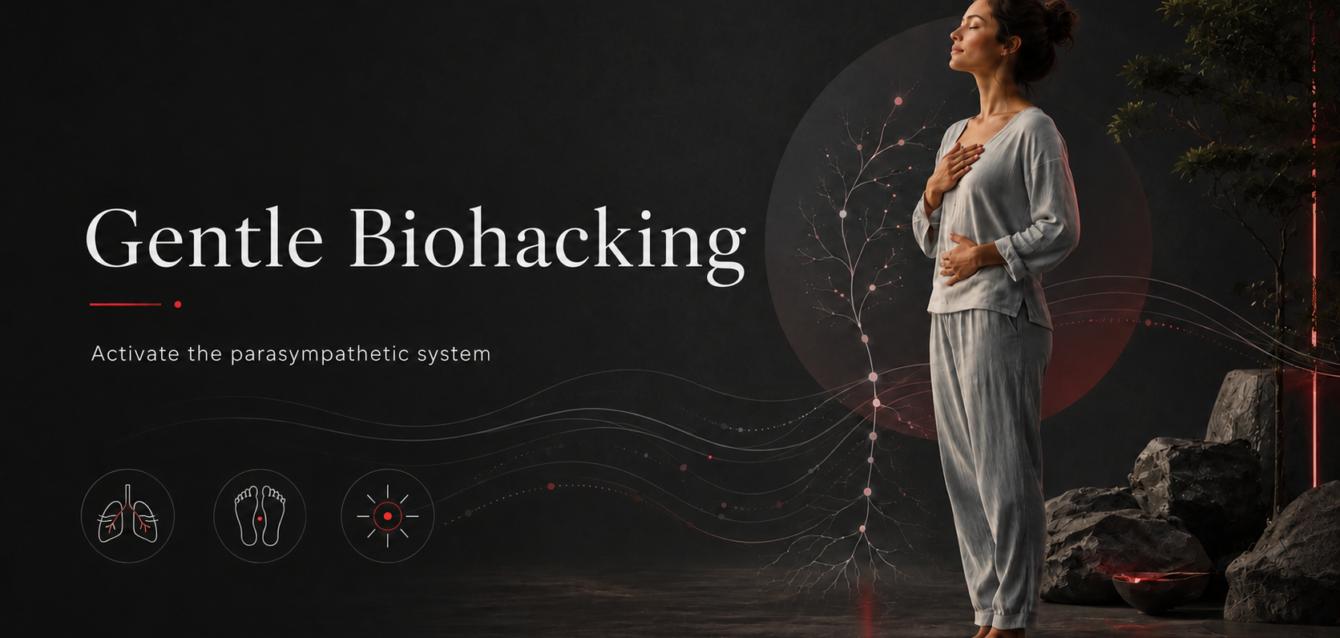
| The word ‘biohacking’ frightens some people. It evokes neural implants, nootropic cocktails, ice baths at 5am. That’s one version. The reality of soft biohacking is much more precise — and much more accessible. It’s the deliberate activation of the parasympathetic system through well-calibrated natural stimuli. No complicated gadgets. No side effects. Just a nervous system functioning as it was designed to. Porges S.W. (International Journal of Psychophysiology, 2001) documented the polyvagal theory: the autonomic nervous system has three states — safety/connection (ventral parasympathetic), mobilization (sympathetic), and immobilization (dorsal parasympathetic). Most humans in 2026 spend too much time in chronic mobilization. Soft biohacking is the art of deliberately returning to the safety state. And the tools to get there are documented, measurable, and reproducible. |
| #1 — What the ANS does — and why most people are out of balance |
The autonomic nervous system manages everything you don’t consciously control: heart rate, digestion, immune response, recovery. Two main modes. Sympathetic mode: action, stress response, energy expenditure. Useful short-term. Exhausting long-term. Parasympathetic mode: recovery, digestion, tissue repair. Where the body heals. Where performance builds between efforts. McCraty et al. (American Journal of Cardiology, 1995) documented the link between emotional states, heart rate variability (HRV) and the parasympathetic system. High HRV = active parasympathetic = improved recovery, concentration, and performance. The problem: most modern performers spend the majority of their day in sympathetic mode. Phone. Notifications. Compensated posture. Dense EMF environment. Constant cognitive load. The parasympathetic never gets time to activate. Soft biohacking is correcting this — deliberately, measurably, without violent effort.
| #2 — 3 natural levers that activate the parasympathetic (no Q-Technology required) |
These 3 practices require no technology. They work on the basis of documented neurobiology.
| Lever 1 — Cardiac coherence (5 minutes, anywhere). Inhale 5 seconds, exhale 5 seconds. Maintained for 5 minutes. Lehrer & Gevirtz (Frontiers in Psychology, 2014) confirmed: this breathing pattern activates the vagus nerve and measurably increases HRV. One of the best-documented protocols for shifting into parasympathetic mode. Lever 2 — Barefoot walking on natural ground (10-15 minutes). The plantar fascia contains among the highest densities of mechanoreceptors in the body. Walking barefoot on variable surfaces — grass, sand, uneven ground — activates these receptors in a way that modern footwear strongly attenuates. Lieberman et al. (Nature, 2010) documented the major biomechanical differences between barefoot and shod gait. The rich proprioceptive signal activates the ANS toward parasympathetic dominance. Lever 3 — Morning natural light exposure (10-15 minutes). Circadian rhythm regulates the sympathetic/parasympathetic cycle over 24 hours. Morning light synchronizes the internal clock and creates conditions for optimal parasympathetic activation in the evening. No technology required. |
| #3 — What Q-Technology adds (and what it doesn’t do) |
Q-Technology doesn’t replace the 3 levers above. It layers on top of them — by improving the quality of the plantar proprioceptive signal from which the ANS receives its information. Kavounoudias & Roll (Journal of Physiology, 2001 and 2003) demonstrated that plantar afferents play a direct role in central postural control. A precise, well-calibrated signal from the point of contact reduces the cortical processing load needed to maintain balance — freeing up resources for other processes, including parasympathetic activation.
| What’s observed across 5,000+ internal tests since 2008: ✓ Visible postural reorganization across all 3 planes in under 12 seconds in 199 out of 200 people. ✓ Improved isometric strength across all 9 demo tests. ✓ EMF test (test 10): up to 20% of isometric strength restored during an incoming call. |
What Q-Technology doesn’t do: it doesn’t force a shift to parasympathetic mode. It doesn’t guarantee stress reduction. It creates the neurobiological conditions for your ANS to organize better — from a more precise sensory input. That’s the difference between a tool and a promise.
| #4 — 3 soft biohacking practices with Q-Technology |
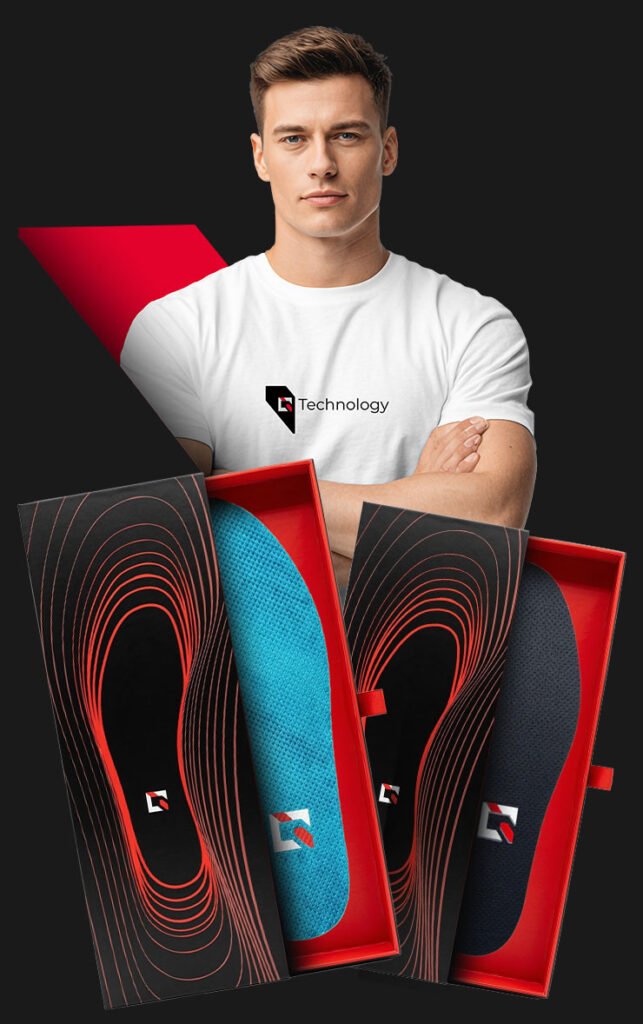
These 3 practices assume you’re wearing Q-Technology — Q-Go (Harmonia, universal) or Q-Pro (calibrated to your biophysical profile via the Perfect Posture Test). They don’t work the same way without the applied technology.
| Practice 1 — Standing postural observation (2 minutes). Standing, feet on your Q circuits, eyes closed. Observe without forcing: where is your weight? Are your shoulders symmetric? What’s the quality of your grounding? After 12 seconds, the technology has produced its effect on proprioceptive input. This observation gives you a baseline to understand what changes. Practice 2 — Amplified cardiac coherence (5 minutes). The 5-minute cardiac coherence practice (lever 1 above) done standing on your Q circuits combines both effects: diaphragmatic breathing + proprioceptive recalibration. Users report a different perceived anchoring quality compared to the same practice without Q-Technology. Individual results vary. Practice 3 — Extended exhale discharge (3 minutes, seated or standing). Seated, feet resting on your Q circuits. Exhale twice as long as you inhale (4 sec inhale, 8 sec exhale). This extended expiratory ratio is documented to activate the vagus nerve and parasympathetic tone. Combined with Q-Technology’s proprioceptive signal, it’s one of the most accessible practices to activate recovery mode. |
| #5 — Assess your ANS state right now: the 120s demo |
Before adopting any soft biohacking practice, it’s useful to know where you’re starting from. The 120-second demo — 10 functional tests with a friend, no equipment — reveals your CNS state right now. The most revealing tests for ANS load assessment:
| Test 1 — Deltoid: arm horizontal, friend presses down. If it gives easily — your ANS is in high sympathetic load. Test 4 — Closed fist: fist clenched, friend pulls up. If your foot lifts off — postural anchoring is insufficient. Test 9 — Trunk rotation: feet together, rotate during exhale. Less than 60° at hips = blocked rotational chain. Test 10 — EMF effect: arm extended, phone ringing in opposite hand. Up to 20% strength lost during incoming call. |
→ Test 1 — deltoid: youtu.be/dmLkjsi-yW0
→ Test 4 — closed fist: youtu.be/mRcCkOpatKw
→ Test 9 — trunk rotation: youtube.com/shorts/MDc4BSouWj0
→ Test 10 — EMF effect: youtu.be/xXeg1lVgHJg
→ Full HUB video (10 tests): youtu.be/TshswH2CSig
The certified Q-Technology tester then measures what changes with the technology applied. The before/after difference gives you a concrete measure of the CNS effect.
| #6 — Soft biohacking: what it is not |
Soft biohacking is not mandatory meditation. Not New Age. Not detox. Not an idealized ‘return to nature’. It’s ANS physiology applied to daily life — with documented tools, measurable results, and a simple logic: deliberately activate the parasympathetic so the body recovers, organizes, and performs better. Cardiac coherence is measurable by a smartwatch. HRV is a standard biometric indicator. Q-Technology’s postural recalibration is observable in 12 seconds, before/after, in front of you. Not faith. Measurement.
| CTA: Test your ANS state right now with a friend — 10 tests, 2 minutes, no equipment. → 10 full tests: youtu.be/TshswH2CSig or meet a certified Q-Technology tester to see the difference with the technology applied. Free 120s demo. Perfect Posture Test: €33 — refunded if zero objectifiable result. 1 tester per 100,000 inhabitants. → Interactive certified tester map: https://www.google.com/maps/d/u/0/viewer?hl=fr&ll=42.054508036620206%2C-12.415899745390398&z=3&mid=1fod64m5u5_8RXc8fsdP7SpDkq3pSQHI |
| 📚 Scientific references • Porges S.W. — The polyvagal theory. International Journal of Psychophysiology, 2001 • McCraty R. et al. — Effects of emotions on short-term HRV. American Journal of Cardiology, 1995 • Lehrer P.M., Gevirtz R. — HRV biofeedback: how and why does it work? Frontiers in Psychology, 2014 • Kavounoudias A. & Roll J.P. — Plantar mechanoreceptors and central postural strategy. Journal of Physiology, 2001 and 2003 • Lieberman D.E. et al. — Foot strike patterns in habitually barefoot versus shod runners. Nature, 2010 |