


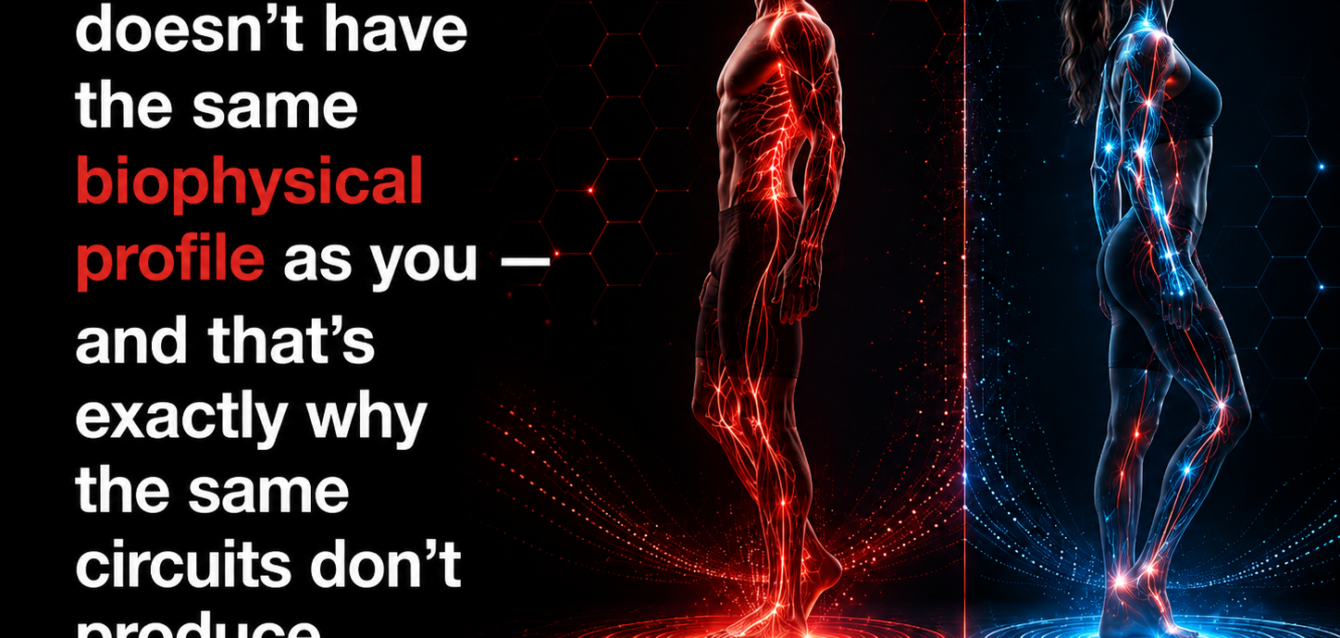
Individual variability in proprioceptive response has been documented since 2002. The 4 Q-Technology biophysical profiles are a direct consequence. Here’s what it changes in practice.
| Kevin and Sarah train together. Same sport, same level, same program. They both decide to try Q-Technology. Result 12 seconds after application with a certified tester: Sarah sees full postural reorganization across all 3 planes. Kevin sees partial improvement — some tests improve, others don’t. Same technology. Different results. Not an error — an information. Sarah is a Theta profile. Kevin is an Alpha profile. They were both wearing the same Q-Go circuit (Harmonia, universal profile) — which works for most people, but not optimally for everyone. With a Perfect Posture Test, Kevin would have identified his Alpha profile and worn the right Q-Pro circuit. That’s ultra-personalization in postural neurology. Not a marketing promise — documented physiology. |
| #1 — Inter-individual variability: what science has said since 2002 |
Peterka R.J. (Journal of Neurophysiology, 2002) published one of the landmark studies on multisensory postural integration. His conclusion: individuals don’t use the same sensory weightings to maintain balance. Some rely more on vision. Others on vestibular afferents. Others on plantar afferents. These weightings are individual. They vary according to age, training level, sensory history, and neurological factors unique to each person. Proske U. & Gandevia S.C. (Physiological Reviews, 2012) add: proprioceptive acuity varies considerably from one individual to another — and this variability is consistent over time for the same individual. It’s not random. It’s a signature. Horak F.B. (Age and Ageing, 2006) completes the picture: postural orientation and balance strategies are individually determined. There’s no single correct way to organize balance — there are several, according to each person’s neurological configuration. Direct implication: a technology acting on sensory input from the point of contact cannot produce identical results in two individuals with different neurological signatures. Not a flaw. Science.
| #2 — The 4 biophysical profiles: where do they come from? |
Nicolas Desjardins identified 4 distinct biophysical profiles over 17 years of practice and 5,000+ tests. Not an arbitrary classification — a reproducible observation of how the CNS responds to different calibrations of sensory input from the point of contact.
| ● Alpha profile : optimal response to a calibration frequency inspired by embryonic dynamics. Most common in high-level strength athletes. ● Theta profile : optimal response to a Schumann resonance-inspired frequency (7.83 Hz). More frequent in meditative practitioners, sensory-sensitive individuals, long-duration sedentary workers. ● Omega profile : synergetic — responds to both registers simultaneously. Often observed after age 50 or in workers with high levels of stress. ● Harmonia profile : universal coherence (Q-Go). Universal entry point — produces observable results in the vast majority without prior testing. More frequent in children and highly adaptive CNS individuals. |
Profile identification happens through the Perfect Posture Test — 15 minutes with a certified tester. Progressive calibration of the three Q-Pro profiles, with observation of postural response across all 3 planes at each step.
| Passive • Non-invasive • No battery • No electrode | Functional observations from Q-Technology internal tests | Individual results vary |
| #3 — What this changes in practice: Q-Go vs Q-Pro |
Here’s the distinction most people don’t understand before their first Perfect Posture Test.
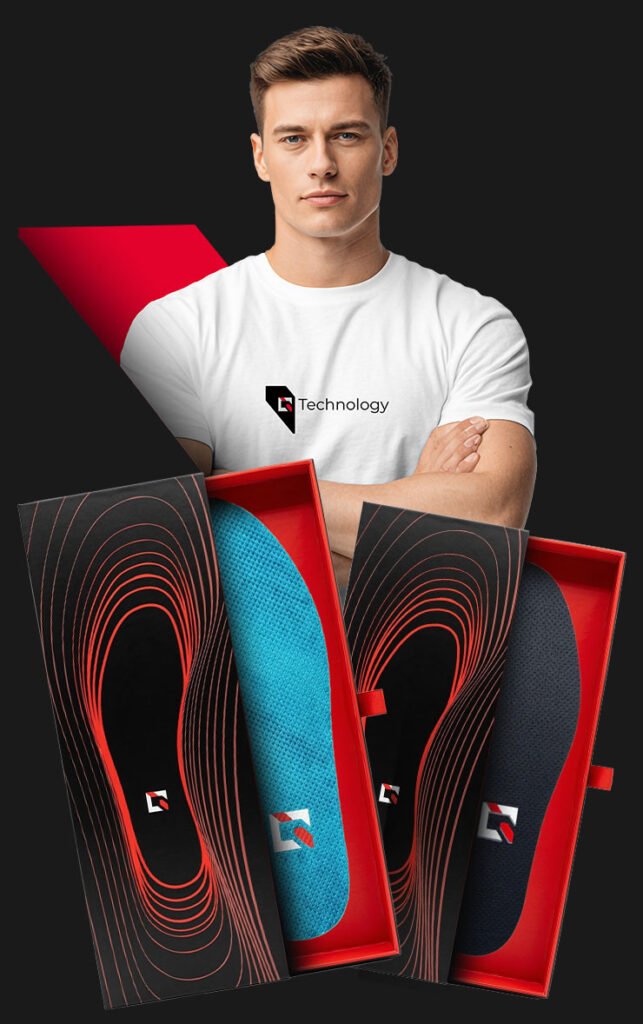
| Q-Go (Harmonia): universal. No test required. Produces observable effects on global tone, stability and the EMF test for most users. Recommended entry point if you haven’t done your Perfect Posture Test yet. Q-Pro (Alpha, Theta or Omega): calibrated to your profile. Requires the Perfect Posture Test (15 min, certified tester, €33 — refunded if zero result). Produces full postural reorganization across all 3 planes — sagittal, frontal, transverse — in under 12 seconds. That’s where true personalization operates. |
The difference isn’t cosmetic. Across the 9 functional tests of the 120-second demo, the Q-Pro version calibrated to the right profile systematically produces more complete results than Q-Go — for Alpha, Theta and Omega profiles. Lending a Q-Pro Alpha circuit to a Theta profile: suboptimal results. No harm — just a calibration that doesn’t match the person’s neurological signature. Like lending prescription glasses.
| #4 — Why ‘one size fits all’ doesn’t work in postural neurology |
The problem with standard ‘corrective’ insoles or universal postural technologies is precisely this. They assume a homogeneous proprioceptive response across individuals. Research has said otherwise since 2002. Peterka (2002) showed that sensory weighting strategies vary considerably between healthy individuals. Not between sick and healthy — between normal, different individuals. In practice: a technology that ‘improves posture’ for 80% of users may do nothing — or produce a different result than expected — for the remaining 20%. Not because the technology doesn’t work, but because it’s not calibrated to their neurological signature. Q-Technology solved this with the 4 biophysical profiles and the Perfect Posture Test. The technology doesn’t assume your profile — it identifies it, then adapts. That’s the difference between a generic correction and a precise neurological calibration.
| #5 — How to identify your profile now |
| Option 1 — Perfect Posture Test with a certified tester (recommended if you want precise calibration). 15 minutes. Successive calibration Q-Alpha → Q-Theta → Q-Omega. Postural observation across 3 planes at each step. The profile producing the most complete reorganization = your profile. Perfect Posture Test demonstration video: youtu.be/Nx5xllIamKc Option 2 — Start with Q-Go (Harmonia) without testing. Universal entry point. Observable effects in the vast majority of users on tone, stability and EMF test. Lets you experience Q-Technology effects before investing in Q-Pro calibration. Option 3 — Run the 10 demo tests right now with a friend. These tests reveal your CNS state before any Q-Technology application. They show you what the certified tester will measure. |
→ 10 full tests (HUB): youtu.be/TshswH2CSig
→ Test 1 — deltoid (most revealing): youtu.be/dmLkjsi-yW0
→ Q-Technology circuits guide (how to wear, duration): youtu.be/CsnODptqMlA
| #6 — What we observe with the right calibration |
Across 5,000+ internal tests since 2008, here’s what’s observed with the correct calibration for the identified biophysical profile:
| ✓ Visible postural reorganization across all 3 planes (sagittal, frontal, transverse) in under 12 seconds in 199 out of 200 people. ✓ Isometric strength improved across all 9 demo tests — before/after, measured by the certified tester. ✓ Wider trunk rotation. Improved lateral pelvic stability. Stronger central anchoring. ✓ EMF test (test 10): strength restored to baseline during an incoming call. Particularly notable in Theta and Omega profiles. |
With the wrong calibration: some of these effects are partial or absent. That’s why the Perfect Posture Test exists — and why the result is guaranteed.
| CTA: Identify your biophysical profile with a certified Q-Technology tester. Perfect Posture Test: 15 min, €33 — refunded if zero objectifiable result across all 3 planes. 1 tester per 100,000 inhabitants — verifiable on Google Maps. → Interactive certified tester map or start by testing your CNS right now: → 10 tests with a friend (2 min, no equipment): youtu.be/TshswH2CSig |
| 📚 Scientific references • Peterka R.J. — Sensorimotor integration in human postural control. Journal of Neurophysiology, 2002 • Proske U., Gandevia S.C. — The proprioceptive senses. Physiological Reviews, 2012 • Horak F.B. — Postural orientation and equilibrium. Age and Ageing, 2006 • Kavounoudias A. & Roll J.P. — Plantar mechanoreceptors and central postural strategy. Journal of Physiology, 2001 and 2003 |