


30% of people aged 65 fall every year: the problem isn’t muscular
Age-related decline begins in the nervous system—not in the muscles. Six published studies explain why. And what you can do now.
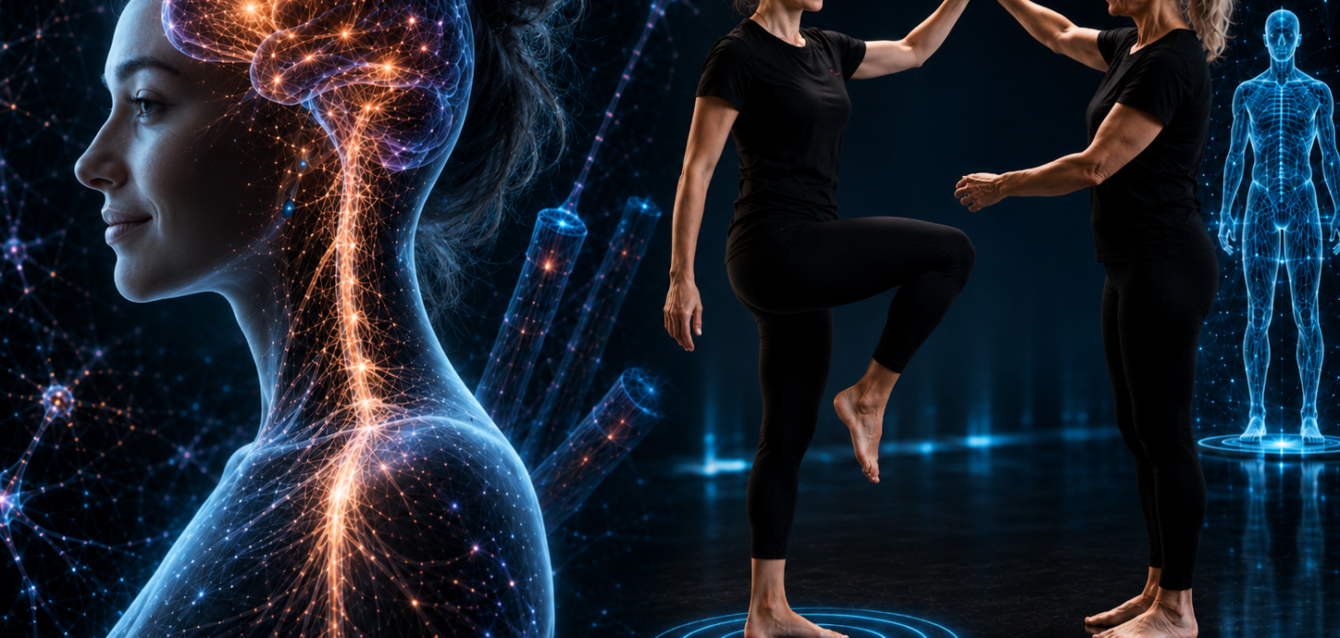
Time doesn’t fix it. That’s true. But the reason is more precise than you think. It’s not the muscles that give out first. It’s the neurological feedback loop that deteriorates. Mechanoreceptors lose precision. The proprioceptive signal becomes less accurate. The brain receives an increasingly inaccurate map—and compensates. Until it can’t anymore.
30% of people aged 65 fall every year. Falls are the leading cause of accidental death in this age group (Xie et al., Experimental Physiology, 2025). Not chronic diseases. Not cardiovascular events. Falls.
This article discusses proprioceptive decline with age—what it is, what research has been saying for the past 20 years, and why Q-Technology has been interested in it from the start. 8 studies. No medical claims. No “anti-aging” buzzword. Just documented neurophysiology.
1 — What really declines with age (hint: it’s not muscle first)
Sarcopenia—loss of muscle mass—is well-documented with age. Everyone knows that. But it comes after something else. Proprioceptors decline first. A study published in PMC by the Society of Physical Therapy Science (2024) measures this directly: a quantified decline in muscle mechanoreceptors in older adults, with a loss of precision in postural control. The muscle is there. But the information it receives and sends to the CNS is degraded. What this means in practice: your 68-year-old patient who ‘loses their balance’ doesn’t necessarily have weak muscles. They have a less precise proprioceptive feedback system. The brain is working with incomplete data. It compensates—through extraneous tension, asymmetries, and rigidity. Until the fall.
A review published in ScienceDirect (Goble et al., KU Leuven, 2008) summarizes 30 years of research: proprioceptive deficits clearly exist in older adults, and they impact stability, balance, and sensorimotor tasks. This isn’t a hypothesis. It’s 30 years of converging literature.
2 — Cervical proprioception: the weakest link after age 65
The study by Reddy et al., published in Healthcare MDPI (2023), is particularly telling. 200 participants — 100 under 65 years old, 100 over 65 years old. Measurement of cervical proprioception, functional mobility (Berg Balance Scale, Timed Up and Go), and postural stability.
Result: Above 65 years of age, cervical proprioception, functional mobility, and stability limits are all impaired. The cervical proprioception score (joint position error) is directly correlated with the decline in functional mobility. The worse the proprioception, the more the body loses its ability to move safely. The neck is one of the three postural systems. Along with the eyes and feet, it constantly sends information to the central nervous system (CNS) about the head’s position in space. When this signal is impaired, the CNS operates with incomplete triangulation. This is one of the mechanisms that Q-Technology targets through the recalibration of CNS information.
3 — What 2025-2026 Research Adds
Two recent studies clarify the picture. Xie et al., Experimental Physiology (2025): Aging and balance control under mastoid vibration. Older subjects show an increased reliance on plantar proprioception to compensate for the decline of other systems. This means that when vision deteriorates, when the vestibular system loses precision, the foot takes on the bulk of postural control. If the foot itself is poorly calibrated, the entire system is compromised.
The study published in npj Aging (Nature, 2026) adds a surprising finding: older adults don’t necessarily lose precision in joint positioning, but they develop a hyper-illusory experience of movement. The brain interprets proprioceptive signals less reliably. It’s not just the signal that is dampened; central processing deteriorates.
Practical translation: a clear, rich, and precise proprioceptive signal from the foot becomes even more critical with age. Not less. More.
4 — What the CNS Does When Proprioceptive Signal Degrades
The CNS doesn’t give up. It adapts. But its adaptations come at a cost. When mechanoreceptors send a less precise signal, the brain increases tonic compensation. It stiffens certain areas to ‘secure’ the structure. It reduces the available range of motion. It slows postural reflexes—because it doesn’t trust the input signal.
A PMC review (2019) on the importance of proprioception in older adults puts it clearly: the decline in proprioception with age is associated with a decline in muscle spindle tone and axonal atrophy—which slows nerve transmission and reduces the speed at which proprioceptive signals are processed. At the central level, this translates into a progressive decline in dendrites in the motor cortex. This central decline explains why muscle strengthening alone isn’t enough. You can have the muscles—but if the signal that orchestrates them is noisy, the movement remains compensated. This is exactly what the Q-Technology Perfect Posture Test measures: the CNS’s ability to use the three postural systems (eyes, inner ear, feet) in a coordinated way. Before/after—on all three planes—in 15 minutes.
5—Q-Technology in this context: what we observe and what we don’t claim
Q-Technology is not an anti-aging program. This term is forbidden in our communications—and for good reason: it is scientifically indefensible and creates expectations that no technology can meet. What we’ve observed in over 5,000 internal tests since 2008: Q-Technology produces proprioceptive recalibration, with an effect on central postural strategy visible in less than 12 seconds in 199 out of 200 people. This is directly in line with the work of Kavounoudias & Roll (Journal of Physiology, 2001 and 2003) on plantar afferents and postural control.
For aging adults, plantar proprioceptive input is precisely what bears the brunt of postural control—as Xie et al. (2025) have just confirmed. Improving the quality of this input doesn’t stop aging. But it can maintain a more efficient postural strategy for longer. That’s different. That’s honest. And that’s measurable.
The Q-Go profile (Harmonia) is the entry point without prior testing. The Q-Pro profiles (Alpha, Theta, Omega) require a Perfect Posture Test with a certified tester—because the individual biophysical profile determines which calibration produces the best result. Applying the wrong signature yields suboptimal results.
6 — What Works Outside of Q-Technology (and What Doesn’t)
Research is clear on one point: proprioceptive training can slow decline. The PMC review (2019) confirms this: a tailored proprioceptive program is fundamental to maintaining the best possible fitness level in older adults. Stability, coordination, posture, balance limit control—all can be improved with targeted training. What works: training on unstable surfaces, single-leg balance work, closed-chain proprioceptive exercises, slow multi-plane movements. The Sensors MDPI (2024) study on postural control on varying surfaces confirms that spinal muscles respond best to instability—and that even in the middle-aged group, degradation is beginning to appear.
What doesn’t work on its own: isolated muscle strengthening. Repeated planks. Gym machines. Anything that works the muscle but not the neurological system that governs it. And what makes it worse: prolonged immobility. Every week without rich proprioceptive input accelerates signal degradation. The CNS learns by doing. Immobility impoverishes it.
7 — Test your CNS now: the 120-second demo
The 120-second demo is a self-assessment protocol anyone can do. No equipment required. In 2 minutes, it reveals the functional state of the nervous system through 9 postural and neuromuscular tests. These four tests are particularly revealing for assessing proprioceptive decline:
Test 4 — Closed Fist. With your fist clenched and your arm at your side, a friend gently pulls you upward. If your foot lifts off the ground, your central nervous system (CNS) is unanchored. → youtu.be/n-yM3ke3Sbc
Test 8 — Gluteus Medius. A friend pushes your hip laterally during exhalation. If your pelvis gives way, lateral stabilization is insufficient. This is common in seniors at risk of falling. → youtube.com/shorts/xwMBELAAL3w
Test 9 — Trunk Rotation. Feet together, rotate during exhalation. Less than 60° at the hips or less than 90° at the trunk — the rotational chain is blocked. Clear signal of chronic myofascial compensation. → youtube.com/shorts/jJWhxwWQ0tM
Test 10 — EMF Test. Left arm extended horizontally. Active phone held in the opposite hand. A friend tests your strength. Then someone calls your phone — without answering. Observed result: up to 20% isometric strength lost during the incoming call. → youtu.be/AVK017_BQ30
Full HUB video: youtu.be/d_qZ02IGDPc These tests do not diagnose a pathology. They reveal a functional state. If the results surprise you — it’s a good time to meet with a certified tester.
Find a certified Q-Technology tester near you. 1 tester per 100,000 inhabitants — verifiable on Google Maps. Perfect Posture Test: 15 minutes, €33, fully refunded if no objective results are obtained. → [INTERACTIVE MAP LINK]
📚 Scientific References
- Xie et al. — Aging, balance control and mastoid vibration, Experimental Physiology, 2025
- PMC 2024, Society of Physical Therapy Science — Quantified decline of proprioceptors in older adults
- npj Aging Study, Nature, 2026 — Hyper-illusory movement experience and proprioceptive decline
- Reddy et al. — Cervical proprioception and functional mobility in 65+ adults, Healthcare MDPI, 2023 (DOI: 10.3390/healthcare11131924)
- Goble et al., KU Leuven — 30-year literature review on proprioception and aging, ScienceDirect, 2008
- PMC 2019 — Importance of proprioception in older adults, falls, and cortical motor decline
- Sensors MDPI 2024 — Postural control, age, and unstable surfaces (doi: 10.3390/s24216846)
- Kavounoudias A. & Roll J.P. — Plantar afferents and postural control, Journal of Physiology, 2001 and 2003
- Ganz & Latham 2020 — Falls: the leading cause of accidental death in people aged 65+