


And that’s why another coffee doesn’t fix it. What the research on the nervous system says — and what Q-Technology does about it.
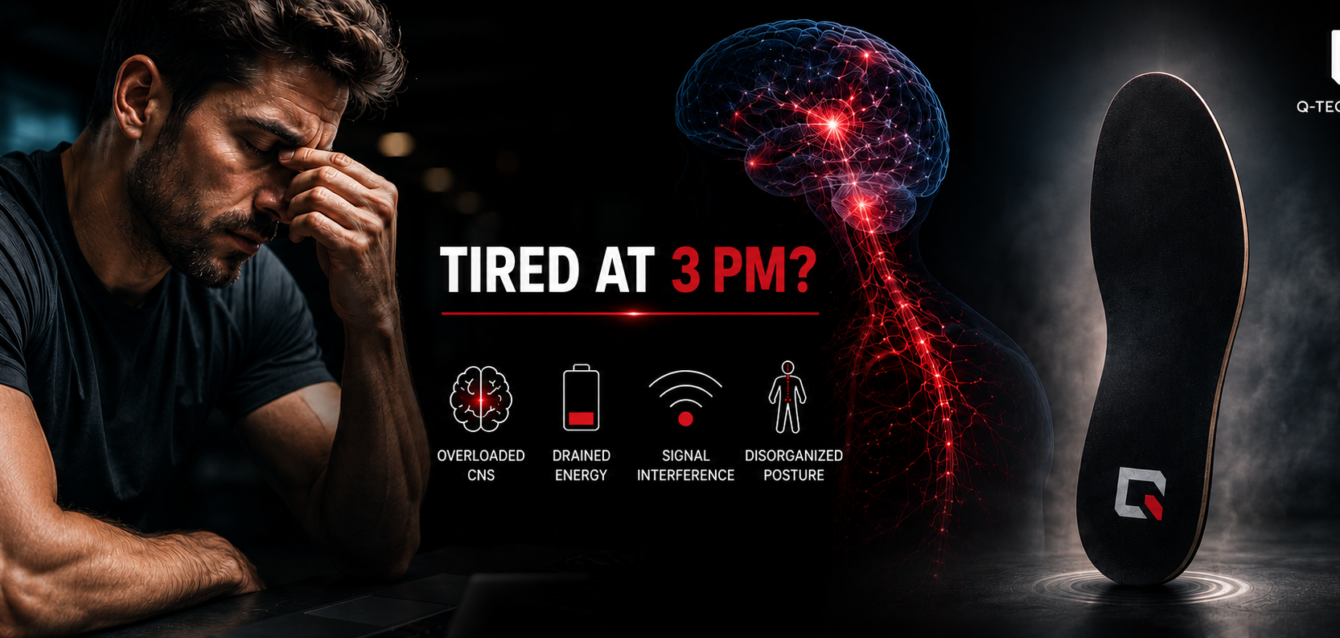
| You sleep well. You eat right. You train. And you’re still wrecked by 3pm. This isn’t weakness. It’s not sleep debt. It’s your central nervous system running on overload since morning. Your CNS burns massive amounts of energy stabilizing your posture, compensating muscle imbalances, managing electromagnetic signals from your environment — Wi-Fi, Bluetooth, phones — and coordinating everything in real time. All of this in the background. All of this before you’ve done a single productive thing. That’s the real cost of performer fatigue. And if you don’t target that source — you can drink all the coffee you want. |
| #1 — What your nervous system does in the background (and what it costs) |
Picture a computer with 47 open tabs. It works. But slowly. And it overheats. Your CNS is the same. It constantly manages 3 postural systems: eyes (horizontal axis), inner ear (sagittal plane), feet (vertical axis). It coordinates muscle chains. It filters sensory signals. It adjusts reflexes. When these systems are well-calibrated, all of this runs on low energy. When they’re not — the brain works twice as hard to compensate. It overheats. You experience it as fatigue. Neurological fatigue: not a fuel shortage — an overload on the management system. This is documented across 5,000+ Q-Technology internal tests since 2008: correcting proprioceptive input from the foot immediately changes the CNS’s postural strategy. Less compensation = less energy expenditure = more energy available for everything else.
| #2 — Why caffeine doesn’t fix the problem (and what does) |
Caffeine masks fatigue. It doesn’t address its cause. It blocks adenosine — the molecule that signals tiredness to your brain. The signal is muted. But the CNS overload remains. Worse: when caffeine wears off, adenosine floods the receptors. Hence the 4pm crash. What the nervous system actually needs: a clear, precise proprioceptive signal from the periphery. Particularly from the feet — the primary entry point for postural control. When this input is well-calibrated, the brain stops over-compensating. The load drops. Available energy rises. That’s exactly the mechanism Q-Technology targets. No chemistry. No stimulation. Just a recalibration of sensory input from the foot.
| #3 — What the 120-second demo tests reveal about your energy right now |
The 10 tests of the 120-second demo don’t directly measure fatigue. They measure something more precise: the quality of the CNS’s motor command at a given moment. An overloaded CNS — regardless of the cause — struggles to orchestrate muscle chains efficiently.
| Closed fist test (test 4): your friend pulls up on your fist. If your foot lifts off the ground — your CNS is unanchored. Gluteus medius test (test 8): your friend pushes your hip sideways. If the pelvis gives — lateral stabilization is failing. Trunk rotation (test 9): less than 60° at the hips means the rotational chain is blocked. |
These deficits are directly linked to CNS load. And they improve with proprioceptive recalibration. Do all 10 tests at home with a friend right now:
→ 10 full tests (HUB EN): youtu.be/TshswH2CSig
→ Test 4 — closed fist: youtu.be/mRcCkOpatKw
→ Test 8 — gluteus medius: youtube.com/shorts/qAnZtUFAPOc
→ Test 9 — trunk rotation: youtube.com/shorts/MDc4BSouWj0
→ Test 10 — EMF effect: youtu.be/xXeg1lVgHJg
| H2 #4 — What Q-Technology produces as observable results |
Across 5,000+ internal tests since 2008, here’s what is observed — before and after application, in practice, in front of the client:
| ✓ Visible postural reorganization on all 3 planes in under 12 seconds in 199 out of 200 people. ✓ Improved isometric strength across all 9 demo tests. ✓ Wider trunk rotation. ✓ Stronger lateral pelvic stability. |
What these observations imply for energy: a CNS that’s no longer compensating a disorganized posture spends less energy in the background. This isn’t direct. It isn’t magic. It’s mechanical.
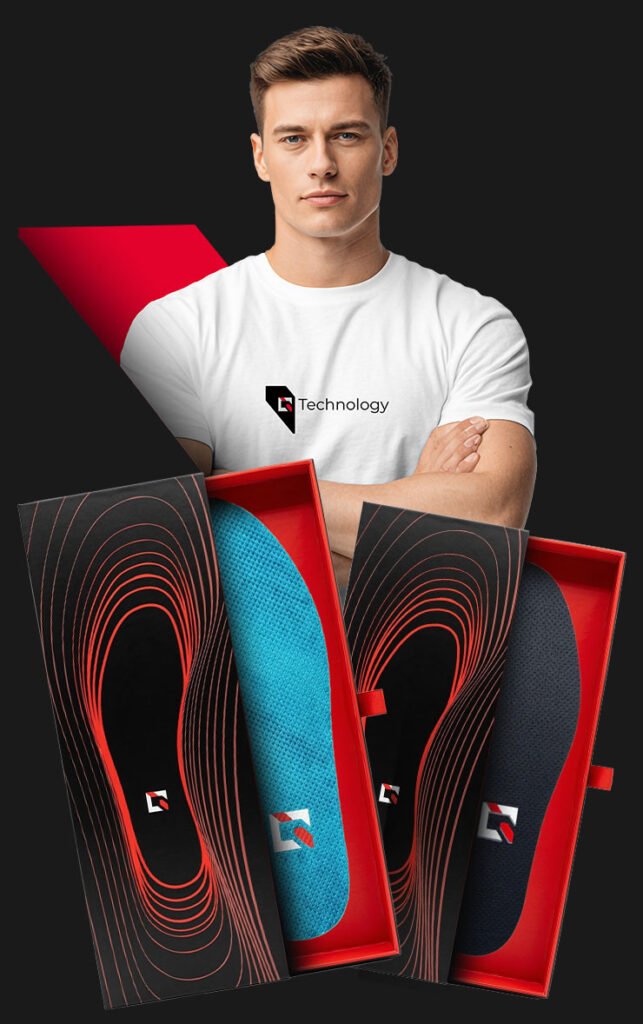
| Q-Go profile (Harmonia): entry point with no prior test required. Observable effects on overall tone and EMF test (test 10). Price: €279 (chips) or €329 (insoles). Q-Pro range (Alpha, Theta, Omega): calibrated to your individual biophysical profile, identified during the Perfect Posture Test. More targeted effects — full recalibration across all 3 postural planes. Price: €449 (chips) or €499 (insoles). |
| #5 — For athletes: what changes in recovery |
When the CNS is better calibrated, it handles training loads with less compensation. What we observe — without making medical claims — in athlete testers:
| ✓ More stable isometric strength at the end of training (measured by demo tests 1, 3, 4). ✓ Wider trunk rotation (test 9) — directly related to swing, throwing, and striking performance. ✓ Improved lateral pelvic stability (test 8) — a key factor in IT band syndrome prevention. |
These aren’t promises of faster recovery. They’re reproducible functional observations on standardized 120s demo tests. Plantar proprioceptive input plays a key role in postural coordination under load — precisely documented by Kavounoudias & Roll (Journal of Physiology, 2001 and 2003).
| #6 — For desk workers and screen-heavy professionals |
8 hours at a desk, in a sitting posture, surrounded by Wi-Fi and screens — that’s a slow, invisible neurological saturation. The CNS maintains sitting posture continuously (anterior chain + spinal stabilizers). It filters EMF signals from the environment. It handles decision-making, focus, and cognitive tasks. All simultaneously. The EMF test (test 10 of the 120-second demo) is particularly striking for this audience: arm extended horizontally, active phone in the opposite hand, someone calls without answering. Observed result across thousands of internal tests: up to 20% of isometric strength lost during the incoming call. Not theory. Filmable, reproducible, verifiable.
→ Test 10 — EMF effect in 30 seconds: youtu.be/xXeg1lVgHJg
Q-Go or Q-Pro worn during the workday modifies sensory input from the foot. What users report in internal tests: improved perceived tone at day’s end, fewer cervical tension complaints on rotation tests. Individual results vary.
| CTA: Test your nervous system right now — at home with a friend, in 2 minutes, no equipment. → 10 full tests: youtu.be/TshswH2CSig Or find a certified Q-Technology tester near you. Free 120-second demo. Perfect Posture Test €33 — refunded if zero objectifiable result. → [MAP LINK — 1 tester per 100,000 inhabitants] |
| Passive • Non-invasive • No battery • No electrode | Functional observations from Q-Technology internal tests | Individual results vary |