

By Nicolas Desjardins, PhD in Natural Medicine · DBA(c) · Master’s in Neuroscience (in progress), designer of the Q-Technology system. Nicolas Desjardins is not a medical doctor. October 2026.
Lire cet article en français : Hyrox : la course compte, les stations rebattent le classement
The short answer. A Hyrox is 8 runs of 1 km, each followed by a functional station, from the SkiErg to the wall balls. Running makes up about half of the race time among the best, but it is the strength stations that reshuffle the rankings most, and, in the PRO and ELITE divisions, they cost the most time among slower athletes. Studies show that intense, or prolonged, effort alters postural control, and that keeping your balance takes attention. Our reading: late in the race, when your attention scatters, the body compensates and your movement breaks down. It isn’t your energy, it’s your attention. During the Test Posture Parfaite, we look at how your body organizes itself, with no equipment, in fifteen minutes.
HYROX is a trademark of its owners. Q-Technology is not affiliated with it.
The format: 8 km of running, 8 stations
The official site sums it up: you run 1 km, then do one station, and repeat eight times. The stations, in order:
- SkiErg: 1,000 m;
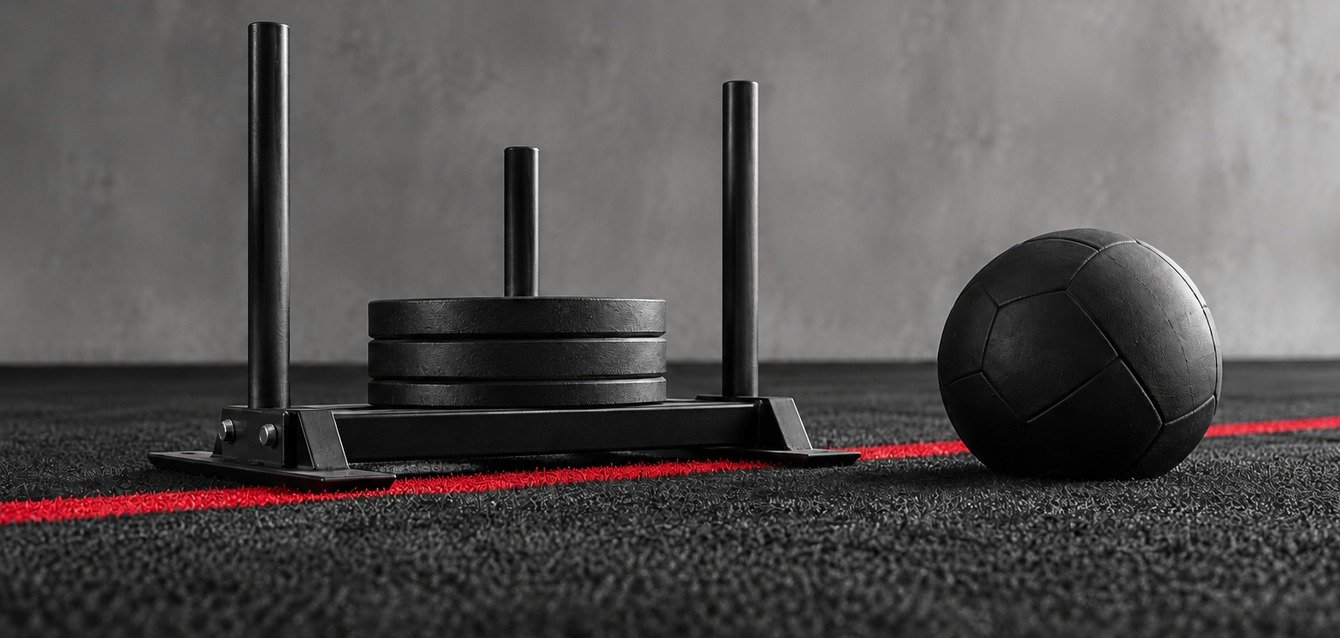
- Sled Push: 50 m;
- Sled Pull: 50 m;
- Burpee Broad Jumps: 80 m;
- Rowing: 1,000 m;
- Farmers Carry: 200 m;
- Sandbag Lunges: 100 m;
- Wall Balls: 100 reps.
The race ends on the wall balls, with no run after. Weights vary by division. Above all, remember the order: three stations where you have to hold your body under load (carry, sandbag lunges, squats with a throw) come last, when you’ve already given everything.
Running matters. But the gap opens at the station DOCUMENTED
- What separates athletes. An analysis of nearly 40,000 results from the PRO and ELITE divisions, over the first seven seasons, shows that overall performance is most strongly linked to running, which accounts for about half of total race time among each season’s top 100. But the strength-dominated stations reshuffle the rankings more, and the time they cost is larger among slower athletes (Rappelt et al., 2026).
- Where the effort peaks. In the first scientific study on Hyrox, 11 recreational athletes completed a full simulation to the standards of the Individual Open Division. Heart rate, blood lactate and perceived exertion reached their highest values on the last exercise: the wall balls (Brandt et al., 2025).
What to remember: running carries the most weight in your race time. But at equal running level, the strength stations are what reshuffle the rankings, and, in the PRO and ELITE divisions, the slower the athlete, the more they cost.
Under load, postural control breaks down DOCUMENTED
A literature review (Paillard, 2012) brought together studies on the effects of general fatigue (the whole body) and local fatigue (one muscle group) on postural control:
- short, intense general exercise increases body sway when the effort exceeds the lactate accumulation threshold;
- exhausting local exercise alters postural control when it causes a loss of at least 25-30% of maximal strength;
- low-intensity exercise can alter it too, if it lasts;
- both general and local exercise make sensory input and motor output less effective, and the body triggers compensatory strategies to counteract or limit the disturbance.
Read that list again with a Hyrox in mind: intense, prolonged effort, muscle groups loaded station after station. You tick several of those boxes. The body doesn’t give out all at once: it compensates.
Keeping your balance takes attention DOCUMENTED
We assume standing upright is automatic. Not quite. A review on attention and the control of posture and gait (Woollacott and Shumway-Cook, 2002) reports that, even in young adults, cognitive factors play a role in controlling balance while standing and walking. The studies use the dual task: the person is asked to keep their balance while doing something else, and researchers look at what breaks down. The attentional demand varies with the complexity of the balance task and the type of second task.
Our reading (an interpretation, not a finding of these studies): a lunge with a sandbag on your shoulders or a squat followed by a throw at a target are complex balance tasks. Late in the race, your attention is already taken by your breathing, the rep count and the noise. Clean movement demands more than you have left. It isn’t a lack of willpower, it’s predictable: what gives out isn’t your energy, but your attention.
What we look at during the test, and what we don’t promise
What we don’t promise: no race time, no ranking, no faster station. The test doesn’t measure your balance on a platform and isn’t done during a race.
What we look at, before and while you wear the circuit, during the Test Posture Parfaite (fifteen minutes, with a certified tester, no equipment):
- the tilts of the pelvis and shoulders on three planes, in centimeters;
- neck rotation, scored out of 7 on each side;
- strength and stability tests, right and left, holding or giving way.
If it shows nothing, the test is refunded.
What we observe OBSERVATION: while the circuit is worn, we observe a postural correction during the test: tilts decrease, neck rotation evens out, tests that gave way now hold.
Functional assessment, non-medical · Before/after protocol · Observations from internal tests · Individual results vary · Not a medical claim.
Our hypothesis HYPOTHESIS: the passive resonant circuit removes nothing and blocks nothing. It gives the nervous system a coherent, stable reference. If that reference lightens part of the work of postural organization, more attention might be left for the movement. This is a hypothesis: we have measured neither attention, nor movement, nor performance in competition, and it may be wrong.
Support, not cure. While you wear the circuit, the effect is there. Take it off, and you’re back where you started, like glasses: you wear them, you see; you take them off, you don’t. Training remains your job.
Passive circuit: no substance. Check with your federation.
FAQ
How many runs and stations are in a Hyrox?
Eight 1 km runs and eight stations: SkiErg, Sled Push, Sled Pull, Burpee Broad Jumps, rowing, Farmers Carry, Sandbag Lunges and Wall Balls. The race ends on the wall balls.
Why does my movement break down on the last stations?
Intense or prolonged effort alters postural control, and balance takes attention. Late in the race, the two add up: the body compensates, and compensation costs time and precision.
Will the circuit improve my race time?
We promise you no race time. What we show happens during the test, while the circuit is worn: tilts, neck rotation, strength and stability tests holding or giving way. Functional assessment, non-medical · Individual results vary.
Is it allowed in competition?
The circuit is passive: no substance, no battery, no electrode. Check with your federation or your event organizer.
How can I check for myself?
Book a Test Posture Parfaite: fifteen minutes, €33, with a certified tester. You compare before and after, on your own body. If it shows nothing, it is refunded.
You train to run. Come and see how your body organizes itself when it has to hold: book your Test Posture Parfaite, refunded if it shows nothing.
Sources
- HYROX, official race format page: https://hyrox.com/the-fitness-race/ (accessed October 2026).
- Rappelt L, et al. Longitudinal performance development in PRO and ELITE HYROX competitions across the first seven competitive seasons. Front Physiol. 2026;17:1847569. https://doi.org/10.3389/fphys.2026.1847569
- Brandt T, Ebel C, Lebahn C, Schmidt A. Acute physiological responses and performance determinants in Hyrox – a new running-focused high intensity functional fitness trend. Front Physiol. 2025;16:1519240. https://doi.org/10.3389/fphys.2025.1519240
- Paillard T. Effects of general and local fatigue on postural control: a review. Neurosci Biobehav Rev. 2012;36(1):162-176. https://doi.org/10.1016/j.neubiorev.2011.05.009
- Woollacott M, Shumway-Cook A. Attention and the control of posture and gait: a review of an emerging area of research. Gait Posture. 2002;16(1):1-14. https://doi.org/10.1016/s0966-6362(01)00156-4