


By Nicolas Desjardins, PhD in Natural Medicine · DBA(c) · Master’s in Neuroscience (in progress), designer of the Q-Technology system. Nicolas Desjardins is not a medical doctor. October 2026.
Lire cet article en français : Peut-on soulager une sciatique en 60 secondes ?
The short answer. None of the official guidelines we cite below describes a method that fixes sciatica in 60 seconds. What they say is simpler, and less of a sales pitch: sciatica usually gets better within a few weeks to a few months, staying active helps, and some signs mean you need to see a doctor right away. We don’t treat your sciatica. We measure what your body does: strength, asymmetry, stability, posture.
First: when to get help now
The UK’s National Health Service (NHS) says to call the emergency services if you have:
- sciatica on both sides;
- weakness or numbness in both legs that is severe or getting worse;
- numbness around your genitals or anus;
- trouble peeing, or you can no longer control when you pee or poo.
If that’s you, stop reading: call 999 in the UK, 911 in the US or Canada, or 112 in the EU. And if the pain doesn’t improve after a few weeks, gets worse or stops you living normally, see your doctor. DOCUMENTED
You typed “60 seconds”. Here’s why it speaks to you
When it pulls from your buttock down to your foot, you want a fix now. The videos promising 60 seconds know that. The problem isn’t that you want it fast. The problem is that a 60-second promise never says what it measures, or what happens the next day.
What the guidelines say DOCUMENTED
In the UK, NICE (guideline NG59 on low back pain and sciatica, 2016, sciatica recommendations updated in 2020) recommends:
- encouraging people to continue with their normal activities;
- considering a group exercise programme;
- not offering foot orthotics, rocker sole shoes, belts or corsets, for low back pain with or without sciatica.
The same guideline also advises against several classes of medicine for sciatica: that’s a conversation for your doctor, not a blog.
The NHS adds everyday advice: keep up your routine as much as you can, move gently as soon as you can, and avoid sitting or lying down for long periods. It says sciatica usually gets better within a few weeks to a few months, but it can last longer and come back.
Takeaway: the official texts don’t promise a quick miracle. They say keep moving, and watch for the warning signs.
What most people get wrong
- “An insole will fix my sciatica.” NICE says exactly the opposite about foot orthotics. We agree with it: we don’t sell you an insole for your sciatica.
- “If it hurts, I should stay in bed.” The guidelines say the opposite: keep up your activities as much as you can.
- “It worked in 60 seconds for someone on video, so it’ll work for me.” A video shows one case, hand-picked, with no measurement before and after. It’s not proof, it’s an edit.
What we do differently: we measure, we don’t promise
We don’t work on your sciatica. We look at how your body organizes itself: its posture, its stability, the strength on each side. When pain lasts, the body often compensates, on one side more than the other; that’s what our test makes visible. HYPOTHESIS: a working hypothesis, not a claim about sciatica
The Test Posture Parfaite takes fifteen minutes with a certified tester, with no equipment:
- your posture observed on three planes, with tilts measured in centimetres;
- your neck rotation, scored out of 7 on each side, before and after;
- your strength and stability tests, which hold or give way.
A test to do at home: the hip (test 8 in the guide)
You can see part of what the tester looks at today, with a partner, in one minute. This test says nothing about your sciatica: it shows whether your pelvis holds sideways, on the right and on the left.
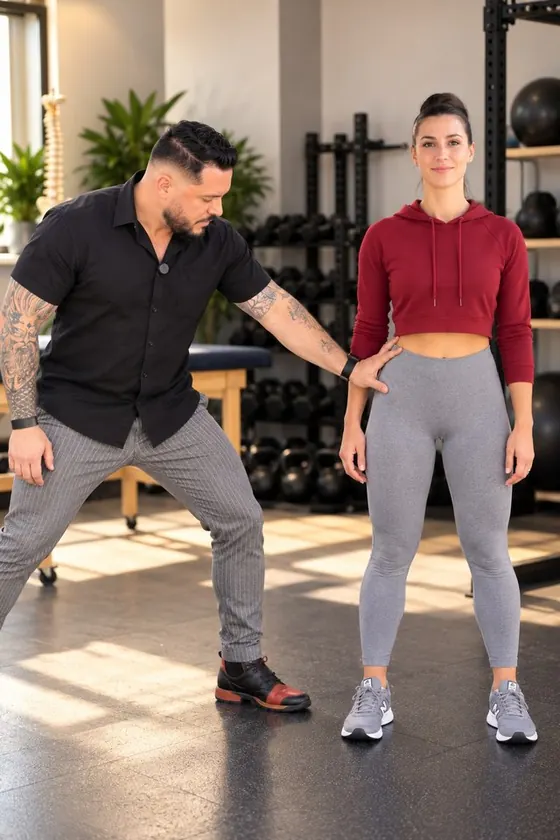
- Stand, legs slightly bent, arms relaxed.
- Breathe in deeply, then breathe out slowly.
- While you breathe out, your partner pushes your hip sideways, under control. Then the other hip.
What it shows: the stability of your pelvis on the side. The trap: it’s the glute on the side opposite the push that holds the pelvis. Pushing on the right tests the left glute.
What it doesn’t show: the origin of your pain. Straight legs, or a push while you breathe in: the test is skewed. And if a movement brings on or increases your pain, stop: this test isn’t for a flare-up.
All 10 tests with photos, plus the grid to note what holds and what gives way: download the free guide.
Functional assessment, non-medical · Before/after protocol · Observations from internal tests · Individual results vary · Not a medical claim.
What we have observed OBSERVATION:
- around 5,000 tests since 2023 with the current circuits;
- 199 people out of 200 reach perfect posture with the calibrated Q-Pro (field observation, not audited);
- on the weak side, strength increases by 39% on average across 7 instrumented measurements (studies). A less-used side may have more room on the second attempt: we always quote this figure with that caveat.
These figures are about posture and strength. They say nothing about your sciatica, and we don’t make them say more. If it’s mostly your lower back that hurts, also read our article on lower back pain.
What to demand before you buy anything
Whether it’s an insole, a patch, a device or a session, ask for:
- A test before and after, on your own body, not a video of someone else.
- A measurement you can see: centimetres, a score, a test that holds or gives way.
- The same test redone in front of you, to see whether the result repeats.
- A written refund condition, before you pay.
If they can’t give you these four things, you’re buying a promise.
FAQ
Can you really relieve sciatica in 60 seconds?
None of the official guidelines cited here (NICE, NHS) describes a 60-second method. They say sciatica often gets better within a few weeks to a few months, and that you should stay active.
Do insoles help with sciatica?
NICE recommends not offering foot orthotics for low back pain, with or without sciatica. Our insoles carry a passive circuit; they are not sold as a treatment for sciatica.
When do I need emergency help?
Sciatica on both sides, weakness or numbness getting worse in both legs, numbness around your genitals or anus, trouble peeing or controlling your bowels: call 999 (UK), 911 (US, Canada) or 112 (EU).
What does the Test Posture Parfaite measure?
Your posture on three planes, your neck rotation on each side, your strength and stability tests, before and after. It’s a functional assessment, not a diagnosis.
What if nothing changes for me?
The test is refunded if it shows nothing (Terms of Sale, article 36).
Book your Test Posture Parfaite: fifteen minutes, €33, refunded if it shows nothing.
Passive · Non-invasive · No battery · No electrode | Functional observations from internal tests | Individual results vary | Not a medical claim.
Sources
- NICE. Low back pain and sciatica in over 16s: assessment and management (NG59), 2016, sciatica recommendations updated in 2020; recommendations 1.2.1 to 1.2.5. https://www.nice.org.uk/guidance/ng59/chapter/Recommendation
- NHS. Sciatica. https://www.nhs.uk/conditions/sciatica/ (accessed 19/10/2026)