


By Nicolas Desjardins, PhD in Natural Medicine · DBA(c) · Master’s in Neuroscience (in progress), designer of the Q-Technology system. Nicolas Desjardins is not a medical doctor. October 2026.
Lire cet article en français : Douleur sous le pied : orthèse, aimant ou rien ?
The short answer. Research focuses mostly on pain under the heel, and its findings are far more modest than the shop-window promises. Foot orthoses do a little better than sham orthoses between 7 and 12 weeks, with no certainty that the gain matters clinically, and custom-made orthoses did no better than prefabricated ones. In two double-blind trials, magnetic insoles did no better than identical insoles without magnets. Even with care, plantar fasciitis can last, and a best practice guide puts taping, stretching and education first. Q-Technology insoles are not orthoses and claim nothing about pain: during the test, we look at your posture, your neck and your strength tests.
Your doctor comes first. Pain under the foot has many possible causes: it is their job to look for them, and this article does not replace their advice. See a doctor without delay if your pain started after a blow, a fall or a twist, if your foot is red, hot and swollen or you can no longer put weight on it, if it comes with fever or unexplained weight loss, if numbness or weakness is spreading, if you lose control of your bladder or bowels, or if it wakes you at night and won’t ease. These are signs for a doctor, not for a functional test.
The first step in the morning, and the insole aisle
The first step in the morning reminds you that your foot exists. In the insole aisle, three promises are waiting for you: the insole that “supports the arch”, the magnetic insole, and the colleague who tells you to wait until it passes.
Here is what the research says: these studies mostly concern pain under the heel (plantar heel pain, often called plantar fasciitis). If your pain is elsewhere, these results don’t necessarily apply to you.
Foot orthoses: a modest effect, in the medium term DOCUMENTED
A meta-analysis pooled 19 randomized trials, or 1,660 adults with plantar heel pain (Whittaker et al., 2018):
- from 0 to 6 weeks, then from 13 to 52 weeks, very low-quality evidence indicates that orthoses do not reduce pain or improve function;
- from 7 to 12 weeks, moderate-quality evidence indicates that they reduce pain more than sham orthoses, with a small effect, and no improvement in function;
- custom or prefabricated: no difference, at any time point.
The authors conclude there is an effect on pain in the medium term, while judging it uncertain whether this change is clinically important. A foot orthosis may have its place, but it isn’t the quick fix you’re being sold.
Magnetic insoles: no better than a sham insole DOCUMENTED
The Mayo Clinic tested them in two randomized double-blind trials (Winemiller et al., 2003 and 2005): in 2003 in 101 adults with plantar heel pain, in 2005 in 83 health care employees with nonspecific foot pain. Both times, the groups with and without magnets improved, with no difference between them: the magnet added nothing. Details in our article on magnetic insoles.
“Nothing” doesn’t really exist: waiting, or starting with the basics DOCUMENTED
Waiting can take a long time. A Danish team followed up 174 patients whose plantar fasciitis had been diagnosed on symptoms and ultrasound, on average almost nine years later (Hansen et al., 2018). At that point, 54% no longer had symptoms and 46% still did. By their estimates, the risk of still having plantar fasciitis was 80.5% one year after symptoms began. These patients didn’t necessarily “do nothing”, and the study, being observational, does not judge the care they received.
The basics first. A best practice guide combined 51 randomized trials (4,351 participants) with the views of experts and of patients (Morrissey et al., 2021). Taping and plantar fascia stretching reduced first-step pain in the short term. The recommended core: taping, stretching, individualized education and, according to the experts, footwear advice. If improvement isn’t enough, the guide then offers shockwave therapy, followed by custom orthoses. The orthosis doesn’t come first, and that choice is made with your doctor, physio or podiatrist, not in a store aisle.
The comparison, without the shop window
| Option | What the research says |
|---|---|
| Foot orthosis | Small effect on pain between 7 and 12 weeks; custom and prefabricated on a par (Whittaker et al., 2018) |
| Magnetic insole | No better than an identical insole without magnets (Winemiller et al., 2003 and 2005) |
| Taping, stretching, education | The recommended core (Morrissey et al., 2021) |
| Letting time do it | In a hospital cohort, treated or not, an estimated 80.5% risk of still having plantar fasciitis one year after symptoms began (Hansen et al., 2018) |
What we look at, and what we don’t touch
We promise you nothing for your foot. We show you what can be measured: the tilts of your pelvis and shoulders, your neck rotation, your strength and stability tests.
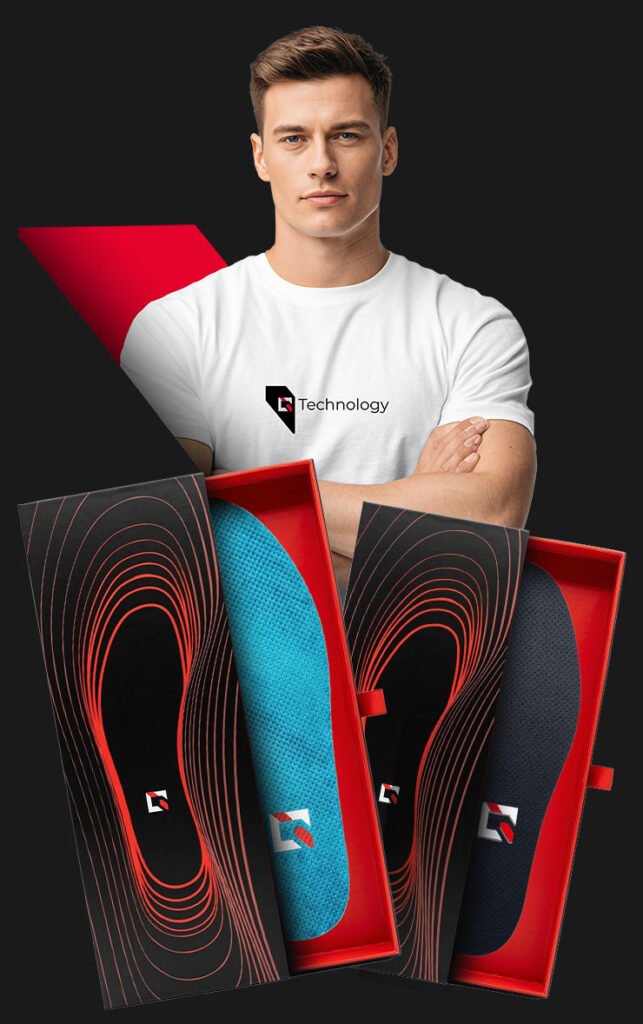
What we don’t touch: your pain. Q-Technology insoles are not foot orthoses: they carry a passive resonant circuit (coil, capacitor, resistor), with no magnet, no battery and no electrode, which also works when worn somewhere other than under the foot. We measure neither your pain nor your foot pressure.
What we look at, before and while you wear the circuit, during the Test Posture Parfaite (fifteen minutes, with a certified tester, no equipment):
- the tilts of the pelvis and shoulders on three planes, in centimeters;
- neck rotation, scored out of 7 on each side;
- strength and stability tests, right and left, holding or giving way.
If it shows nothing, the test is refunded. What “perfect posture” means: our definition.
What we observe OBSERVATION: while the circuit is worn, we observe a postural correction during the test: tilts decrease, neck rotation evens out, tests that gave way now hold. It is the body’s organization while the circuit is worn, and we draw no conclusion from it about your foot or your pain.
Functional assessment, non-medical · Before/after protocol · Observations from internal tests · Individual results vary · Not a medical claim.
Our hypothesis HYPOTHESIS: the passive resonant circuit removes nothing and blocks nothing. It gives the nervous system a coherent, stable reference. This is a hypothesis about the mechanism, and it may be wrong.
Support, not cure. While you wear the circuit, the effect is there. Take it off, and you’re back where you started, like glasses: you wear them, you see; you take them off, you don’t. Your pain remains your doctor’s business.
FAQ
Do foot orthoses work for pain under the heel?
In a meta-analysis of 19 trials, they did a little better than sham orthoses between 7 and 12 weeks (moderate-quality evidence), with no certainty that the gain is clinically important. Before 7 weeks and after 12, the evidence, of very low quality, shows no effect.
Should I pay for custom-made orthotics?
In that meta-analysis, custom orthoses did no better than prefabricated ones, and the best practice guide only offers them as a last step, if the core and then shockwave haven’t been enough. Decide with your practitioner.
Are Q-Technology insoles foot orthoses? Are they magnetic?
Neither. They carry a passive resonant circuit, with no magnet, no battery and no electrode, and they claim nothing about pain. The foot is just a convenient place to wear it.
Does the test measure my foot pain?
No. It measures neither your pain nor your foot pressure. It looks at your function: tilts in centimeters, neck rotation scored out of 7, strength and stability tests, before and after. Functional assessment, non-medical · Individual results vary.
How can I check for myself?
Book a Test Posture Parfaite: fifteen minutes, €33, with a certified tester. You compare before and after, on your own body. If it shows nothing, it is refunded.
Your foot is your doctor’s business. Your posture, come and see it in centimeters: book your Test Posture Parfaite, refunded if it shows nothing.
Sources
- Whittaker GA, Munteanu SE, Menz HB, Tan JM, Rabusin CL, Landorf KB. Foot orthoses for plantar heel pain: a systematic review and meta-analysis. Br J Sports Med. 2018;52(5):322-328. https://doi.org/10.1136/bjsports-2016-097355
- Winemiller MH, Billow RG, Laskowski ER, Harmsen WS. Effect of magnetic vs sham-magnetic insoles on plantar heel pain: a randomized controlled trial. JAMA. 2003;290(11):1474-1478. https://doi.org/10.1001/jama.290.11.1474
- Winemiller MH, Billow RG, Laskowski ER, Harmsen WS. Effect of magnetic vs sham-magnetic insoles on nonspecific foot pain in the workplace: a randomized, double-blind, placebo-controlled trial. Mayo Clin Proc. 2005;80(9):1138-1145. https://doi.org/10.4065/80.9.1138
- Hansen L, Krogh TP, Ellingsen T, Bolvig L, Fredberg U. Long-Term Prognosis of Plantar Fasciitis: A 5- to 15-Year Follow-up Study of 174 Patients With Ultrasound Examination. Orthop J Sports Med. 2018;6(3):2325967118757983. https://doi.org/10.1177/2325967118757983
- Morrissey D, et al. Management of plantar heel pain: a best practice guide informed by a systematic review, expert clinical reasoning and patient values. Br J Sports Med. 2021;55(19):1106-1118. https://doi.org/10.1136/bjsports-2019-101970