

By Nicolas Desjardins, PhD in Natural Medicine · DBA(c) · Master’s in Neuroscience (in progress), designer of the Q-Technology system. Nicolas Desjardins is not a medical doctor. October 2026.
Lire cet article en français : Les semelles magnétiques ont été testées contre une semelle factice
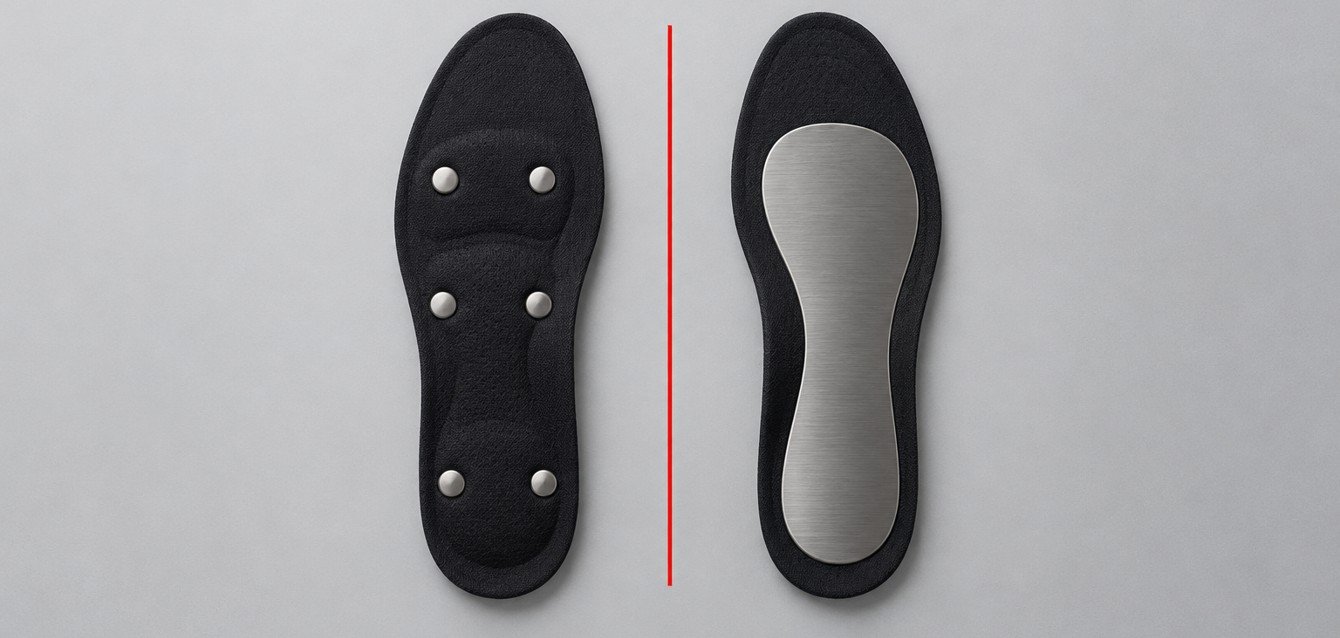
The short answer. Magnetic insoles contain static magnets. Mayo Clinic tested them in two randomized, double-blind trials (2003 and 2005), against identical insoles with a non-magnetized metal sheet inside. The magnetic insoles did no better. Both groups improved by about the same amount: the magnet added nothing, and the authors suggest the cushioning. Q-Technology circuits are not magnets: they are passive resonant circuits. And we don’t ask you to believe us. We ask you to test them on your own body, in fifteen minutes: strength, stability and posture, before and after.
You bought a magnet. Here’s what the research says about it.
A magnetic insole holds permanent magnets. They create a static field, one that does not change. The promises around it are familiar: better circulation, less pain, more energy. One question matters, and it’s a simple one: does the magnet do anything that the insole alone doesn’t?
What the two Mayo Clinic trials found DOCUMENTED
2003, JAMA. 101 adults had suffered from plantar heel pain for at least 30 days. For eight weeks, they wore cushioned insoles: half with active magnets, half with sham magnets. Neither the participants nor the researchers knew who wore which.
- Morning pain scores went from 6.9 to 3.9 out of 10 in the non-magnetic group, and from 6.7 to 3.9 out of 10 in the magnetic group.
- 33% of the non-magnetic group and 35% of the magnetic group said they were “all or mostly better”.
- No outcome measured separated the two groups.
2005, Mayo Clinic Proceedings. This time the researchers enrolled 89 Mayo Clinic healthcare employees with nonspecific foot pain at work; 83 were analyzed. Same principle, double-blind against a sham insole, and the same conclusion: magnetic and sham insoles gave the same results.
In both trials, both groups improved on average; the authors suggest the cushioning. For the 2005 trial, the Mayo Clinic release notes a moderate placebo effect in the people who believed most strongly in magnets.
What to remember: if an insole only works when you believe in it, it isn’t the magnet doing the work.
Static magnet or passive resonant circuit: two different technologies
| Magnetic insole | Q-Technology circuit | |
|---|---|---|
| Inside | Permanent magnets | A coil, a capacitor, a resistor |
| Field | Static and constant | No field of its own: it captures the ambient electromagnetic energy in its resonance band (chargers, power supplies, screens) |
| Battery, electrode | None | None |
| What it returns | Nothing | A coherent, low-frequency signature, still to be characterized on the bench |
| How it was checked | Two double-blind trials (Mayo Clinic): no better than sham | A before-and-after test on the body, and blind tests with a sham circuit |
What we know, and what we don’t:
- ESTABLISHED The circuit is passive.
- ESTABLISHED It captures ambient electromagnetic energy.
- TO CHARACTERIZE It re-emits a coherent signature. No bench session has been run yet.
- HYPOTHESIS The nervous system reads that signature.
- UNKNOWN What happens at the cellular level.
Our working model: everything happens as if the circuit bypassed the exteroceptors and spoke the nervous system’s language directly. That is a model, and it may be wrong. The foot is just a convenient place to wear the circuit. The circuit also works worn elsewhere, and without contact, up to about ten centimeters away.
Don’t believe us. Test it.
We promise you nothing for your heel. We show you what can be measured: strength, asymmetry, stability, posture on three planes.
The Test Posture Parfaite takes fifteen minutes with a certified tester, and it needs no equipment. Here is what you check yourself:
- your posture reorganizing on three planes, measured in centimeters;
- your neck rotation, scored out of 7 on each side, before and after;
- your strength and stability tests, holding or giving way.
To rule out belief, we ran several tests blind, with a sham circuit. If the test shows nothing for you, you get your money back.
Functional assessment, non-medical · Before/after protocol · Observations from internal tests · Individual results vary · Not a medical claim.
Support, not cure. While you wear the circuit, the effect is there. Take it off, and you’re back where you started, like glasses: you wear them, you see; you take them off, you don’t.
What we have observed OBSERVATION:
- about 5,000 tests since 2023 with the current circuits;
- 199 people out of 200 reach perfect posture with a calibrated Q-Pro (field observation, not audited);
- on the weaker side, strength went up by 39% on average across 7 instrumented measurements (studies). The weaker side may simply have more room to improve on a second attempt, so we always quote this figure with that caveat.
Passive · Non-invasive · No battery · No electrode | Functional observations from internal tests | Individual results vary | Not a medical claim.
In their words
“As soon as I take them off, I feel the difference.” — Lino, beginner athlete (testimonial published on our site in March 2026, translated from French)
Individual testimonial · results vary · not a medical claim.
FAQ
Do magnetic insoles work?
In two randomized, double-blind trials at Mayo Clinic, magnetic insoles did no better than identical non-magnetic insoles for foot pain. Both groups improved, and the authors suggest the cushioning: the magnet added nothing.
Are Q-Technology insoles magnetic?
No. The insole only carries a passive resonant circuit: a coil, a capacitor and a resistor. There is no magnet, no battery and no electrode, and the circuit also works when worn elsewhere on the body.
Does the circuit pick up Wi-Fi, 5G or Bluetooth?
No. Its resonance band is far from those signals, so it doesn’t pick them up. It captures the ambient energy given off by chargers, power supplies and screens.
Is it a medical product?
No. The circuit has no medical status, and we make no medical claim. We look at function: strength, asymmetry, stability, posture on three planes.
What if nothing changes for me?
About one person in two hundred doesn’t reach perfect posture, whatever calibration we try (field observation, not audited). The Test Posture Parfaite is refunded if it shows nothing. Passive · Non-invasive · No battery · No electrode | Functional observations from internal tests | Individual results vary | Not a medical claim.
How can I check for myself?
Book a Test Posture Parfaite: fifteen minutes, €33, with a certified tester. You see the result on your own body before you buy anything else.
Book your Test Posture Parfaite: fifteen minutes, refunded if nothing changes.
Sources
- Winemiller MH, Billow RG, Laskowski ER, Harmsen WS. Effect of magnetic vs sham-magnetic insoles on plantar heel pain: a randomized controlled trial. JAMA. 2003;290(11):1474-1478. https://doi.org/10.1001/jama.290.11.1474
- Winemiller MH, Billow RG, Laskowski ER, Harmsen WS. Effect of magnetic vs sham-magnetic insoles on nonspecific foot pain in the workplace: a randomized, double-blind, placebo-controlled trial. Mayo Clin Proc. 2005;80(9):1138-1145. https://doi.org/10.4065/80.9.1138
- Mayo Clinic release, September 2005: https://www.newswise.com/articles/magnetic-insoles-do-not-provide-pain-relief