

By Nicolas Desjardins, PhD in Natural Medicine · DBA(c) · Master’s in Neuroscience (in progress), designer of the Q-Technology system. Nicolas Desjardins is not a medical doctor. October 2026.
Lire cet article en français : Ta posture est-elle bonne ? Le miroir ne te le dira pas
The short answer. There is no single “good posture” you just have to copy. When hundreds of physiotherapists are shown postures, they don’t all agree on the best one, and no strong evidence links any specific posture to better health (O’Sullivan et al., 2012; Korakakis et al., 2019). So the right question isn’t “am I standing up straight?” but “how does my body organize itself when I’m not thinking about standing?”. That organization can be looked at on three planes, from the front, from the side and in rotation, plus one simple marker: neck rotation on each side. The mirror shows you only one plane, reversed, and while you look at it, you strike a pose.
This article is not advice about pain. If you are in pain, see a doctor first, and without delay if you have warning signs: pain after an impact, fever, unexplained weight loss, numbness or weakness that spreads, loss of bladder or bowel control, night pain that doesn’t ease.
“Stand up straight”: even professionals don’t define it the same way DOCUMENTED
- Two “best postures” that look nothing alike. 295 physiotherapists from four European countries chose the best sitting posture from nine postures, ranging from slumped to upright. 85% chose one of two postures, and those two postures were very different from each other. The choice varied from country to country, and the authors conclude that disagreement remains on what a “neutral” spine is (O’Sullivan et al., 2012).
- The same arguments for different shapes. 544 Greek physiotherapists chose an optimal posture from seven sitting and five standing postures. Three sitting postures and two standing postures shared almost all the choices; for sitting, the most popular were variations of “upright with an arched lower back”. And participants justified their choice with the same arguments (natural curves, muscle activation), whatever shape they had chosen. The authors note that upright sitting postures are considered optimal despite a lack of strong evidence that any specific posture is linked to better health (Korakakis et al., 2019).
What to remember: the “good posture” to copy is a widely shared belief. It isn’t a measured standard.
There isn’t one normal back. There are several. DOCUMENTED
A team in Lyon, France, took standing X-rays of 160 volunteers with no spinal symptoms and classified the curve of their lower back into four types. The size of the arch, the position of its peak and the number of vertebrae forming it depended on the tilt of the sacrum, the bone at the base of the spine (Roussouly et al., 2005). In people without symptoms, the arch varies, and it follows the orientation of the sacrum. So there is no model arch to copy.
And the link with back pain? A review of 41 systematic reviews found, depending on the review, both associations and no associations between spinal posture, prolonged standing or sitting, bending, twisting and low back pain. Conclusion: no consensus on causality, and the documented association doesn’t explain the cause (Swain et al., 2020). We promise you nothing for your back.
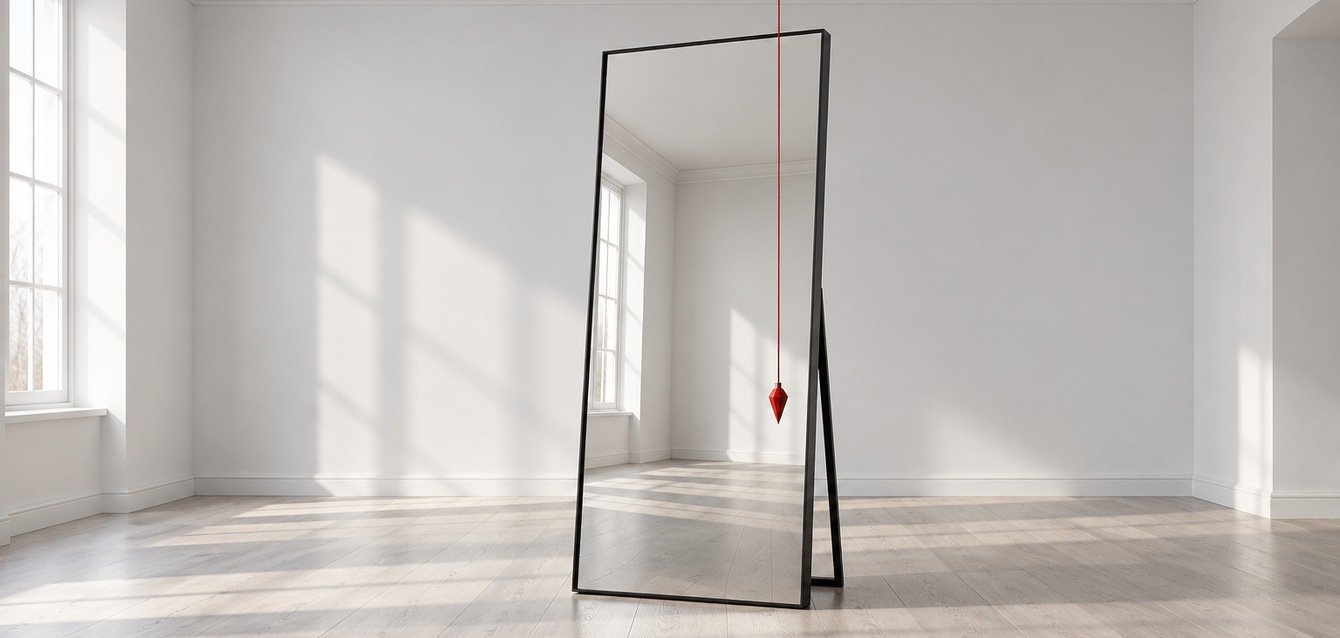
Why the mirror doesn’t tell you the truth
- It shows only one plane. From the front, you see the frontal plane: one shoulder higher, for example. You can’t see your profile (sagittal plane) without twisting your neck. The rotations of the pelvis and shoulders (transverse plane) stay almost invisible.
- It reverses. Your right is on the left: you judge yourself backwards.
- It makes you pose. As soon as you look at yourself, you straighten up: you see your pose, not your posture. And a pose held by willpower doesn’t last, as we explain in Perfect posture: what it really means.
How to check your posture
Forget the pose. Look at the organization, on three planes:
- frontal: are the pelvis and shoulders level on the right and left? Tilts are measured in centimeters;
- sagittal: how your body stacks from front to back;
- transverse: the rotations of the pelvis and shoulders relative to each other.
Add one simple marker, neck rotation: turn your head to the left, then to the right. If one side goes clearly less far, that’s an asymmetry. During the test, it is scored out of 7 on each side, for example 4/7 on the left and 7/7 on the right.
At home, a front and side photo taken without warning you gives a first clue, not a measurement.
At Q-Technology, perfect posture has a precise definition: a “spontaneous postural reorganization on all three planes (frontal, sagittal, transverse), with millimeter precision on the frontal and transverse planes”. It isn’t a pose you imitate, but what happens without you making any effort.
What we look at, what we observe, what we hypothesize
What we look at, before and while you wear the circuit, during the Test Posture Parfaite (fifteen minutes, with a certified tester, no equipment):
- the tilts of the pelvis and shoulders on three planes, in centimeters, down to the millimeter;
- neck rotation, scored out of 7 on each side;
- strength and stability tests, right and left, holding or giving way.
If it shows nothing, the test is refunded.
What we observe OBSERVATION: while the circuit is worn, we observe a postural correction during the test: tilts decrease, neck rotation evens out, tests that gave way now hold.
Functional assessment, non-medical · Before/after protocol · Observations from internal tests · Individual results vary · Not a medical claim.
Across about 5,000 tests since 2023 with the current circuits, 199 people out of 200 reach perfect posture with the calibrated Q-Pro (field observation, not audited). The profile matters: the wrong profile never gives perfect posture. That’s why we test before you choose.
Passive · Non-invasive · No battery · No electrode | Functional observations from internal tests | Individual results vary | Not a medical claim.
Our hypothesis HYPOTHESIS: the passive resonant circuit removes nothing and blocks nothing. It gives the nervous system a coherent, stable reference. This is a hypothesis about the mechanism, and it may be wrong.
Support, not cure. While you wear the circuit, the effect is there. Take it off, and you’re back where you started, like glasses: you wear them, you see; you take them off, you don’t.
FAQ
Is there an ideal posture?
Not a single one. Asked about the “best” posture, hundreds of physiotherapists spread their choices across several different postures, and no strong evidence links any specific posture to better health.
How can I tell if my posture is good?
Look at how your body organizes itself spontaneously: the tilts of the pelvis and shoulders, the rotations, neck rotation on each side.
Is the mirror enough?
No. It shows only the frontal plane, it reverses the sides, and you straighten up as soon as you look into it. Standing up straight through willpower is a pose, not your posture.
What is perfect posture at Q-Technology?
A spontaneous postural reorganization on all three planes (frontal, sagittal, transverse), with millimeter precision on the frontal and transverse planes. 199 people out of 200 reach perfect posture with the calibrated Q-Pro (field observation, not audited). The Q-Go, a universal circuit, makes the quick tests of the 120-second demo hold; perfect posture, however, is what the Q-Pro calibrated to your profile aims for. Passive · Non-invasive · No battery · No electrode | Functional observations from internal tests | Individual results vary | Not a medical claim.
How can I check for myself?
Book a Test Posture Parfaite: fifteen minutes, €33, with a certified tester. You compare before and after, on your own body. If it shows nothing, it is refunded.
The mirror shows you your pose. Come and see your posture, on three planes: book your Test Posture Parfaite, refunded if it shows nothing.
Sources
- O’Sullivan K, O’Sullivan P, O’Sullivan L, Dankaerts W. What do physiotherapists consider to be the best sitting spinal posture? Man Ther. 2012;17(5):432-437. https://doi.org/10.1016/j.math.2012.04.007
- Korakakis V, et al. Physiotherapist perceptions of optimal sitting and standing posture. Musculoskelet Sci Pract. 2019;39:24-31. https://doi.org/10.1016/j.msksp.2018.11.004
- Roussouly P, Gollogly S, Berthonnaud E, Dimnet J. Classification of the normal variation in the sagittal alignment of the human lumbar spine and pelvis in the standing position. Spine. 2005;30(3):346-353. https://doi.org/10.1097/01.brs.0000152379.54463.65
- Swain CTV, Pan F, Owen PJ, Schmidt H, Belavy DL. No consensus on causality of spine postures or physical exposure and low back pain: A systematic review of systematic reviews. J Biomech. 2020;102:109312. https://doi.org/10.1016/j.jbiomech.2019.08.006