

By Nicolas Desjardins, PhD in Natural Medicine · DBA(c) · Master’s in Neuroscience (in progress), designer of the Q-Technology system. Nicolas Desjardins is not a medical doctor. October 2026.
Lire cet article en français : Ton 1RM ne voit pas ton côté faible
The short answer. To increase strength, most programs track one overall number: your 1RM, your total load, the weight on the bar. That number says nothing about how the work is split between your right side and your left side. Research confirms that inter-limb asymmetries are common, but their link with performance is inconsistent and task-specific: a systematic review (Bishop et al., 2018) associates them mainly with jumping, kicking and cycling, with no randomized trials. One finding is clearer: in 45 elite academy soccer players, the dominant side in the two-leg jump agreed poorly with the dominant side in the single-leg jump (Bishop et al., 2022). During the Test Posture Parfaite, we look at your strength tests on the right and on the left, holding or giving way, with no equipment.
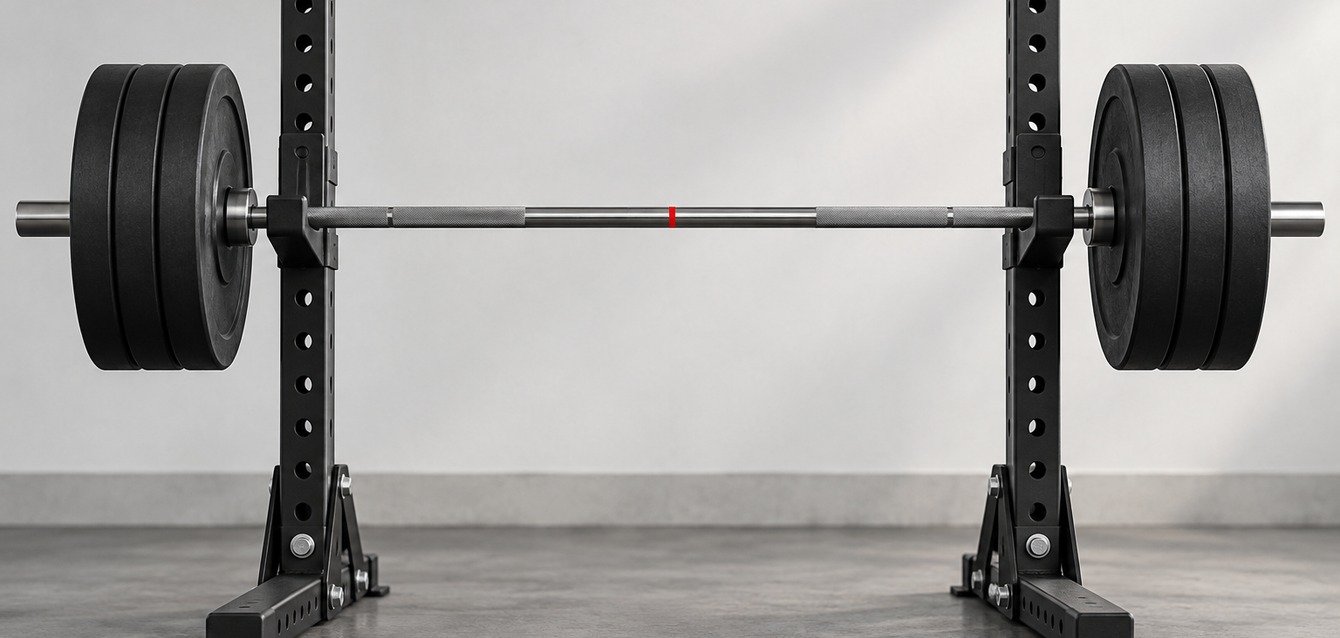
Your barbell can’t count to two
Squat, deadlift, bench press: one bar, two sides, one number. When your 1RM goes up, you log progress. What you never log is who did the pushing.
On a bar, nothing forces your two sides to put in the same effort. The overall number is useful. It is simply blind to what happens between right and left.
What research really says about asymmetry DOCUMENTED
Asymmetry is often sold to you as the obvious culprit. The literature is more nuanced.
- The reference review. Bishop, Turner and Read (2018) included 18 studies relating asymmetry scores to performance measures. Inter-limb differences in strength may be detrimental to jumping, kicking and cycling. When asymmetry is measured in jumps, its link with change-of-direction speed is mixed. Measured in sprinting, dynamic balance or sport-specific actions, the findings are inconsistent. And all these studies are associative: no randomized trials. We see links, not causes.
- In middle- and long-distance running. A more recent systematic review (D’Hondt et al., 2024) included 8 studies in healthy runners: 16 negative associations, 1 positive and 30 with no clear association. According to the authors, most asymmetry metrics are either not associated or negatively associated with performance, and methods are too heterogeneous for a simple conclusion.
What to remember: no one can tell you today that a given percentage of asymmetry costs you a given percentage of performance. Asymmetry exists, it depends on the task, and it deserves to be looked at rather than assumed.
A two-leg test doesn’t tell you which side gives way DOCUMENTED
- Bilateral versus unilateral. In 45 elite academy soccer players (under-16, under-18 and under-23), Bishop et al. (2022) compared the two-leg jump and the single-leg jump. The magnitude of asymmetry was similar from one test to the other, but the dominant side agreed poorly: the leg that produced more force on two legs rarely dominated on one leg as well. The authors advise against using one test to represent the other.
- A dominant side that moves. In 19 under-20 academy players followed over a season, asymmetries decreased, but the dominant side agreed poorly from one time point to the next (Bishop et al., 2023). The authors describe limb dominance as fluctuating.
What to remember: even in closely monitored elite players, a two-leg test doesn’t necessarily tell you which side dominates on one leg. Your 1RM doesn’t even separate the sides. And today’s answer isn’t necessarily next month’s.
The body compensates: the strong side works for two HYPOTHESIS
Here is our reading, and it is a hypothesis: when one side gives way earlier, the body doesn’t stop, it redistributes. The strong side takes a bigger share of the load, and the bar goes up anyway. The overall number holds, but it plateaus earlier, because one side is working near its limit while the other keeps something in reserve.
What we see during the test OBSERVATION: in many people, strength tests give way on the same side. The link with the weight on your bar remains a hypothesis. Functional assessment, non-medical · Individual results vary.
You’re not plateauing. You’re compensating.
What you can do at your next session, without buying anything: add single-leg or single-arm tests, compare both sides, and repeat them a few weeks apart. The studies above suggest it: one test isn’t enough, and the weak side can change.
What we look at during the test, and what we have observed
What we look at, before and while you wear the circuit, during the Test Posture Parfaite (fifteen minutes, with a certified tester, no equipment):
- strength and stability tests, right and left, holding or giving way;
- the tilts of the pelvis and shoulders on three planes, in centimeters;
- neck rotation, scored out of 7 on each side.
What we don’t promise: your 1RM, your total load, the weight on the bar. We announce no figure on your performance, and the test measures no load and uses no device. We show you what can be measured: your strength tests, right and left, holding or giving way. If it shows nothing, it is refunded.
What we observe OBSERVATION: while the circuit is worn, strength tests that gave way on one side now hold, and posture reorganizes on three planes (see what we mean by perfect posture).
Functional assessment, non-medical · Before/after protocol · Observations from internal tests · Individual results vary · Not a medical claim.
What we have measured in our studies OBSERVATION: on the weak side, strength increases by 39% on average across 7 instrumented measurements (studies). Caveat: a less-used side may have more room to improve on the second attempt. These measurements come from studies; they are not part of the test.
Passive · Non-invasive · No battery · No electrode | Functional observations from internal tests | Individual results vary | Not a medical claim.
Our hypothesis HYPOTHESIS: the passive resonant circuit removes nothing and blocks nothing. It gives the nervous system a coherent, stable reference. This is a hypothesis about the mechanism, and it may be wrong.
Support, not cure. While you wear the circuit, the effect is there. Take it off, and you’re back where you started, like glasses: you wear them, you see; you take them off, you don’t. The circuit replaces neither your program nor your unilateral work.
FAQ
How do I know if I have a weak side?
Test each side separately, on one leg or one arm, right then left. A two-leg test isn’t enough: in elite soccer players, the dominant side in the two-leg jump rarely matched the one in the single-leg jump (Bishop et al., 2022).
Does strength asymmetry lower performance?
Not always, and not everywhere. A systematic review associates it mainly with jumping, kicking and cycling, with inconsistent findings elsewhere and no randomized trials (Bishop et al., 2018). In distance running, most of the associations tested were negative or absent (D’Hondt et al., 2024).
Why is my 1RM stuck when I train well?
There are many possible causes: program, volume, technique, nutrition. Our hypothesis, and it may be wrong: one side that gives way earlier and another that compensates. The overall number can’t tell them apart; side-by-side tests at least show which one gives way. We promise nothing about your 1RM.
Does the test measure my strength with a device?
No. The test is done with no equipment: strength and stability tests on the right and the left, holding or giving way. The 7 instrumented measurements cited above come from studies. Functional assessment, non-medical · Individual results vary.
Can I wear the circuit in competition?
Passive circuit: no substance. Check with your federation.
How can I check for myself?
Book a Test Posture Parfaite: fifteen minutes, €33, with a certified tester. You compare your strength tests on the right and the left, before and while wearing the circuit. If it shows nothing, it is refunded.
Your program sees your total. Come and see both your sides: book your Test Posture Parfaite, refunded if it shows nothing.
Sources
- Bishop C, Turner A, Read P. Effects of inter-limb asymmetries on physical and sports performance: a systematic review. J Sports Sci. 2018;36(10):1135-1144. https://doi.org/10.1080/02640414.2017.1361894
- D’Hondt J, et al. Association Between Inter-Limb Asymmetry and Determinants of Middle- and Long-distance Running Performance in Healthy Populations: A Systematic Review. Sports Med Open. 2024;10(1):127. https://doi.org/10.1186/s40798-024-00790-w
- Bishop C, et al. Bilateral vs. Unilateral Countermovement Jumps: Comparing the Magnitude and Direction of Asymmetry in Elite Academy Soccer Players. J Strength Cond Res. 2022;36(6):1660-1666. https://doi.org/10.1519/JSC.0000000000003679
- Bishop C, et al. Seasonal Variation of Physical Performance, Bilateral Deficit, and Interlimb Asymmetry in Elite Academy Soccer Players: Which Metrics Are Sensitive to Change? J Strength Cond Res. 2023;37(2):358-365. https://doi.org/10.1519/JSC.0000000000004248